What could possibly go wrong? Gus travelling from Jersey to Heathrow with BA, me flying from Glasgow to Heathrow at almost the same time, linking up in T5 and flying on together to Innsbruck also with BA.
Well, for one thing, weather in either Jersey or Glasgow or both and/or weather in Heathrow. Then there could be technical problems with one or other of the planes which probably had a flight before our individual flights to Heathrow. You also have to factor in the possibility of delays or cancellations due to staff shortage and baggage handler problems, and weather or air traffic control restrictions anywhere else in the UK or Europe that morning that could affect our fights.
Would one of us making it to Heathrow and one of us not? Would both sets of bags and skis make the connection at Heathrow – we’d only find out at Innsbruck Airport? Would the only Innsbruck flight from Heathrow that day be cancelled so that we’d have to go to Gatwick – if there were seats on that later flight – or Zurich like last time we did the trip 2 years ago, when we arrived in Lech after midnight? Would the taxi at Innsbruck Airport be there? Would the mountain road from St Anton to Lech be open if there was a heavy snowfall that day?
Gus had booked to come from Cape Town to Jersey, also with BA , only 2 days earlier – another high risk element of our undertaking. Now I go through all this, recounting all the risks of everyday travelling that increased exponentially in the aftermath of lockdown, we must have been crazy to even think we could meet up at Heathrow and go skiing together.
But in fact none of these problems occurred. Not one. It all went like clockwork. We arrived at the hotel in Lech in good time to get sorted out well before (the 5 course) dinner that included Wiener Schnitzel. And I won’t hear a word said against BA; I’m one of their biggest fans, as readers of the first Kenya safari story will know.
We had 11 skiing days in between the 2 days travelling there and back. Or rather, 11 days that potentially we could have skied as long as the weather behaved (which it didn’t). To be able to ski at all, the first thing you have to do on Day 1 after you leave the hotel and ski down a short way to the village is buy your lift pass.
Now both of us are over 65; so as long as you’ve remembered to bring ID that shows your birthday, you can get a senile git discount. The charming lady at the ticket office, speaking impeccable English in return to my stumbling German, advised that we should buy a season pass as it was cheaper for periods of more than 6 days.
Then it dawned on me. “Oh”, I said to Gus as he was buying his pass, “I’m coming back here in March, so can I use the pass then too?”, to which, having overhead my musings while still dealing with Gus, the lady replied with a smile: “Absolutely you can”. An unexpected bonus.
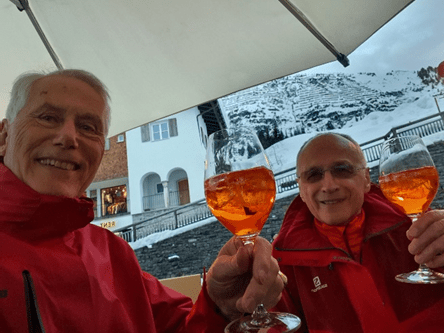
I’m going to spare you a day by day turn by turn description of the vacation, but cover things in general and some of the highlights.
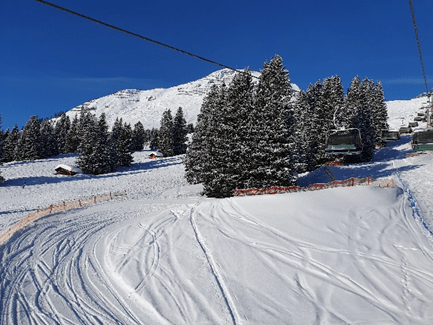
Lech
We had lots of sunshine too, great skiing and overall a great time in Lech –the Austrians do the whole skiing thing so much better than anyone else, in my opinion.
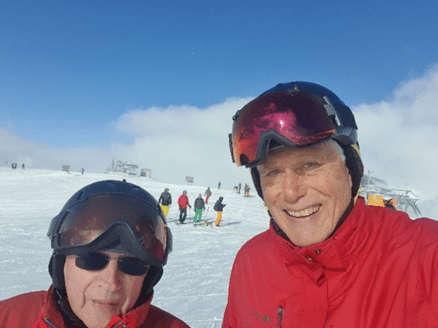
Warth
We found the combination of the weather and the snow conditions, some of which were challenging by our standards. Gus and I are good enough skiers if the conditions are good, but we are a bit choosy as to what constitutes “good”. We like to look as if we know what we’re doing, and it’s all too easy to loose what elegance we have on a variety of snow terrains. For example:
- When the piste suffers from flat light due to low cloud such that you can’t see the terrain, that isn’t good because you are effectively skiing blind.
- Ice, now often referred to as hard packed snow, also doesn’t constitute good in our books.
- Neither does snowing or raining – wet, can’t see the piste because of the low cloud cover gives you flat light, and you need wipers for your goggles.
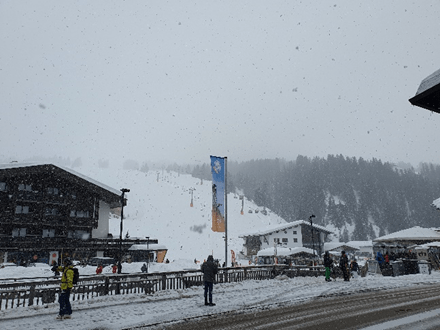
Lech Dorf im Schnee
- Gus in particular doesn’t like strong arctic wind conditions at the top of the mountains. At 60 kph, the resort kept the chairs to the higher slopes running, but at 90 kph they didn’t and more than half the slopes were shut, which then led to …..
- Crowded slopes, which doesn’t constitute good either because it’s best to avoid bumping into other people and you have to be so aware of the myriad possibilities of what other skiers might do.
- We don’t like warm weather either, because it makes the snow softer and heavier, like porridge as I call it – it takes more energy to turn and is often more mogully (moguls are large bumps of snow that you have to ski round or over and which can easily thropw your balance off).
- Small crusty lumps on top of a hard-packed piste can be simply uncomfortable to ski on.
- And really cold weather, say -10C or below, even with the sun shining, isn’t what we want either, because at any kind of speed you get the wind chill effect.
Brrrrr
We encountered all these conditions either singly or in combination over the 11 days. We completely sat out two days, sadly one being Gus’s birthday (mainly very poor visibility) and the other being our last day (snowing and raining). On three other days, we only skied for half a day. Which is why we didn’t do as much skiing as usual.
Sabine’s brother said we went during the worst two weeks of the season weatherwise (probably almost as difficult for a German speaker to say in English as “weathervane” – for those who read an early story “Quoi ne march pas”).
But our limits on skiing in these conditions had a foundation in common sense. We were there for long enough that we didn’t need to be a danger to ourselves. Our game plan certainly was not to wind up like one of the men in a group of Germans at the hotel, who on his first day of skiing returned on crutches with his knee swollen and in a serious brace.
It’s important that you can ski in all conditions because you never know when things might change on the mountain. Neither of us liked the ice. It was intermittent, as in you are skiing along quite happily, then suddenly you hear this scraping sound and your skis begin to slide away from you downhill, which you have to immediately correct by not edging but gliding until you come to better snow where you can turn. It can happen suddenly and, in poor light, without warning.
I only fell once, prompted by my inability to cope with a sudden patch of ice near the edge of the piste on a red run, a gentle fall but one that made one of my skis come off. Fortunately it was near the end of the run because the brakes didn’t release and the ski kept going downhill. The ski even made the left turn towards the chairlift at the bottom, all on its own. It was lucky that no-one was downhill of me at the time as needless to say this state of affairs is very undesirable – i.e. potentially extremely dangerous. The next skier down thoughtfully picked it up and put out of harm’s way. And I had to walk down the edge of the piste carrying one ski to get it.
I was particularly vexed because I’d just had the skis and the bindings serviced. This in part was because the same thing had happened when Sabine and I were skiing with her brother and sister-in-law about two weeks before, but someone was nearby to stop the skis going down the piste. I told them of the problem with the bindings and I was at the shop when they checked and adjusted them, so I know they did look at them. I took the skis back the next morning and they rechecked and adjusted them again, without charge. Fortunately or not, another opportunity to test the bindings didn’t occur as I stayed upright for the rest of the holiday.
The last two paragraphs don’t do justice to how well the skis performed after they had been serviced. The service was clearly overdue, as the grunt from the lovely guy at the ski shop indicated when he saw them. Gus had his done too. With all the ice on the piste, it gave us a lot more confidence that we would cope ok. The hotel agreement with the ski shop meant that they delivered them back not just to the hotel but to our assigned ski lockers before skiing the next morning.
And I think this is the place where I mention the comment by the ski shop guy. We had to fill in a form saying how tall we were, how much we weighed, what our skiing level was and how old we were. When he saw our ages, he beamed and said it was extraordinary that we were still skiing. Gus had a great response “It’s important not to let the old man in”. It has echoed in my head ever since.
Lech had more English and English speakers there than in previous holidays – a lot more. That included Australians, some with their children (summer holidays in the Southern Hemisphere), who we’d never encountered before, and more Americans. That included our hotel. Among the guests were a delightful English couple, Ian and Elaine from St Albans, whose company we enjoyed in the evenings.
For the first time since we started staying at the hotel in 2016, Gus and I were entertained for dinner by the hotel proprietors, a lovely family of three adult children in their mid to late 20s, Matthias, Agnes and Johanes, and Veronica their aunt. Matthias is studying law at Innsbruck Uni, but the other 3 run the hotel, which is only open for the ski season. Another guest who lived in Sydney, Helen, was also invited and our youthful hosts loved the opportunity to practice their English till well past our normal bedtime. A lovely evening.
In previous years, Gus and I skied most of the connected resorts – Lech, Warth, Zurs, St Anton, and Zug. We never went to Stuben but you can. We’d even skied the route called Der Weisse Ring which takes you from Lech to Zurs to Zug (via a reasonably difficult itinerary) and back to Lech, but this year we stayed mainly in Lech with a couple of trips over to Warth, where we found the slopes less enjoyable – usually it’s the reverse.

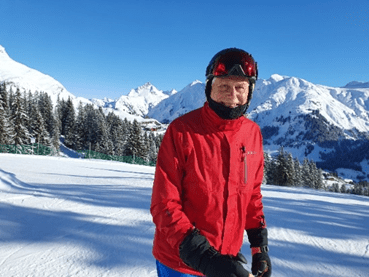
Birthday Boy
On the two days of not skiing at all and one of the half days, we made our way to Zug, about 3km away. The first time, on Gus’s birthday, we walked through enchanting woods near the hotel with fresh snow clinging to the branches and the air very still, as it can get during and just after a snowfall. We arrived at Der Rote Wand (The Red Wall) hotel and restaurant, looking forward to our mid-morning coffee.
We went into the reception and turned right to the restaurant where we could see people sitting. A receptionist came rushing up behind us and told us in no uncertain terms to be point of rudeness: “Es ist geschlossen. Wir sind nicht öffnen bis Mittag” – It‘s closed. We‘re not open till midday.
To say we were stunned is putting it mildly, first by her attitude, completely the opposite to the welcome and service we’d experienced everywhere else in Lech and on the mountain, and second by our disappointment – no coffee. We turned around, walked a different way to Lech, had coffee there and never went back to Rote Wand. I doubt we ever will. The subsequent two visits to Zug for lunch were very successful at another hostelry, das Alphorn.
We came away at the end of the holiday feeling happy with ourselves. We’d skied well enough in difficult conditions (for us at least) and still enjoyed it. No, we hadn’t skied all day every day, but given the conditions, we had nothing to chastise ourselves about. And didn’t hurt ourselves or anyone else. Alles gut!


Sounds like a wonderful trip!
LikeLike
Absolutely loved the quote by Gus too right! Certainly one to remember 😊
LikeLike
Good evening Peter!
<
div dir=”ltr”>Thank you for letting us participate
LikeLike
Very funny!
LikeLike