May 2023
As we know all too well, life can change in an instant. One such instant for me happened in May while looking at the birds on the bird feeder. I sensed a rustle low down in the foliage to one side of it and out popped a rat. It arrived furtively, looked around and then quickly made itself at home, hunkering down and calmly hoovering up the bird seed on the ground dropped by the birds from the feeder above.
It put a shiver down my spine – like someone walking over my grave, isn’t that the saying? A feeling of utter revulsion (and fear?) that on rats can impart. I suspect everyone has the same reaction to these pernicious creatures. Certainly Sabine did and so did the two tough Glaswegians working on our balcony renovation.
You’ve been told that they’re everywhere, town and country, but if you don’t see them, you can pretend that fact doesn’t actually apply to you, that they’re everywhere but not in your neighbourhood. The cats down the road are hunters (we’ve seen them at it), so they must have scared them off. Apparently not, in our case. Actually seeing them brings with it a realisation that you’d much rather not have, that you’ve been blissfully fooling yourself.
And indeed I had stupidly thought we’d got away with it, but there was always a nagging doubt that it wouldn’t last …. and sure enough. But I should be forgiven for being that naive because the problem took long enough to materialise. We’d started feeding the birds months before, when we first moved into the house the previous September in fact, and all through winter the feeders were inundated with hungry avians eager to enjoy the gastronomic delicacies, mostly sunflower seed hearts, our bird restaurant had on offer.
Sunflower seeds are very popular with the birds. The oil provides them with a lot of energy per seed and they are smart enough to know this. Smarter than a lot of people who buy any old seed mix, only to see most of it scornfully discarded by the birds who wouldn’t waste the energy they need for digestion on the nutrient-free crap served up in those restaurants. So the first rule of bird feeding is to provide something the customer wants – so obvious because it applies to the hospitality business everywhere.
But don’t be fooled into buying the black sunflower seeds unless you like clearing up the husks. They are a lot cheaper because the husks make up a lot of the volume, but the birds have to do a lot more work to get at the nutritious part. Our birds don’t have to do that – they’re spoilt rotten because we offer only sunflower seed hearts, already shelled.
I always think that a good restaurant has a simple menu with only a few courses made from good ingredients to choose from as starters, mains and desserts. We’ve followed that line of reasoning, offering only three main-course options – sunflower seed hearts, fat balls and peanuts. Each course requires its own feeder, so I had to do a lot of research (a PhD is next on the list) looking at various websites to decide which type of feeder to buy and not surprisingly there was a lot of choice. And I didn’t get it right first time either, so maybe the research wasn’t good enough for a PhD.
The sunflower seed hearts are the clear favourite, by a mile. Next are the fat balls, but the peanuts are largely untouched. I had hoped that we could attract a Great Spotted Woodpecker to them but no such luck – I’ve only heard one once or twice in the woods nearby, so perhaps we don’t have a resident. I suspect they would be eaten if they were the only thing on offer, but as they can go mouldy in our rainy climate if left uneaten in their feeder, there’s a footnote on the menu now – peanuts only by special request.
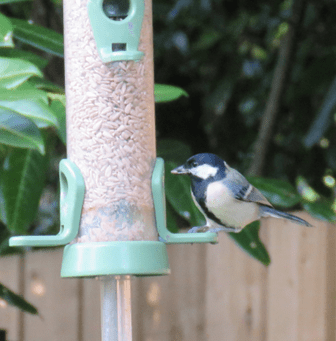
Our birds come to the feeder with two very different types of eating styles The Tits (Blue, Great and Coal) are tidy and elegant, they wait their turn if the feeder is busy, their visits to the feeder usually being fleeting, a quick but orderly in and out, picking one seed at a time which they carry off and eat elsewhere, freeing the perch for the next bird. More akin to a take-away service. They’re clinical, purposeful. They can choose to discard a seed but there’s not a lot of wastage. I get the impression that they really appreciate what’s on offer and are keen not to cause a mess in return. Like people at a motorway service station who carry their trays to the trolley when they leave.

Long-tailed Tits are a particular favourite of ours. That’s when you know you’re running a family restaurant because the whole family arrives en-masse. Thoughtfully, they’ve waited till they have the place to themselves, so no queuing with other birds and there is an orderly procession of these cute little birds with long tails to both the sunflower and the fat ball feeders.


However, there are other, slightly larger birds, mainly Goldfinches, Greenfinches, Chaffinches and Siskins, that descend on the feeder in gangs (“flocks” is too a nice word that doesn’t do justice their bully boy tactics). They fly in, they haven’t made reservations, they get upset possibly to the point of being abusive if the restaurant perches are already full, hang about the bushes until one comes free, and push and shove other birds out of the way that are trying to do the same thing. Pigs at the trough (like some humans at a buffet?). They even dive bomb birds on the perches in the hope that they will vacate their seat at the table. And size matters.
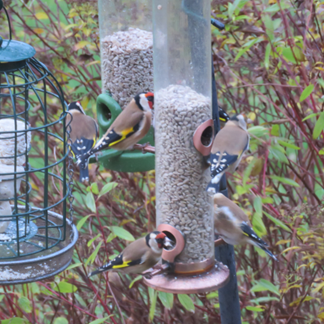

To cap it all, once at the feeder, they throw their food around like little children, discarding any seed that doesn’t meet their nutritional standards. On closer observation, I’ve also noticed that they don’t eat with their mouths closed (beaks in their case), and while crushing the chosen seed in half to make it easier to swallow and digest, the half that isn’t in their beak falls to the ground too. Absolutely no manners whatsoever. But the last photo above, a goldfinch waiting in the spirea for a perch to come available, makes you forgive everything.
And there was a silver lining: the area underneath became a secondary feeding station. We had the pleasure of watching other birds seemingly not so comfortable with feeders, principally Dunnocks and Robins and the occasional Blackbird, happily availing themselves of the discarded seeds on the ground. Pleasure is the wrong word for watching the fat Wood Pigeons pecking away – they were too big for the feeders or simply too lazy given that easier access to food was available on the ground.
One evening Sabine saw two hedgehogs (mother and bairn) feeding on the discarded seeds. They were very cute, happily snuffling about minding their own business but they froze when Ernie, the chihuahua, found them. He barked at them but wisely kept his distance until he was scolded and recalled. They’d gone when Sabine looked for them again.
I’m very happy to report that, touch wood, fingers and toes crossed and rabbit’s foot stroked, the rat-under-the-feeder problem seems to have gone away, but not without a great deal of ingenuity, determination and perseverance on my part. I thought it would be simply a matter of doing some Google research, choose the solution that people had assigned 5 stars to, place the Amazon or RSPB order and install the new feeder system when it arrived a couple of days later. Dream on.
At the outset, the most urgent question was to carry on feeding or not. The month of May is very important in the bird breeding calendar, and denying food to our faithful repeat restaurant customers that they possibly had grown dependent on was a very upsetting option. Selfishly, we would be denying ourselves of seeing them looking resplendent in their breeding plumage. Did we want to see both the rats and birds or nothing at all?
We chose the latter, very quickly, in fact the same day. We’d seen enough of the rat population to know we didn’t need to see them anymore. We had workmen close by and the rats seemed quite indifferent to them, but that sense wasn’t returned by the workmen. They weren’t impressed at all. Which meant we had to move fast.
And unless we could come up with a solution, this could be a permanent arrangement. The birds were frantic at first, flying up to the feeder station that no longer had food, finding nothing, flying around it, and finally calling us names. It was all very upsetting for both the birds and us.
I must admit to having been a wee bit angry too – we can’t be the first feeder of birds to have this problem, so why wasn’t there an easy answer? All the stuff I was reading on the internet was about how to stop squirrels climbing up the pole to the feeder and how very expensive feeders or covers with dangling chains could prevent them and the larger birds such as Magpies and Crows accessing the feed while allowing access to the smaller birds. Nothing about rats apart from “you need to stop feeding the birds”.
What to do? Some time in my working life, along with my colleagues at Midland Bank in Jersey, I had to do a behavioural attributes self-assessment test for something called Belbin, which was all about making teams of people work more effectively. Fascinating stuff, easy to understand, not so easy to implement – but great for consultants as it created a self-perpetuating and continuous need for them.
There are 9 roles within any properly balanced team, so the theory goes. I scored well on two roles, co-ordinator and plant. The former seemed to me to be reasonable understandable as that actually was my job, but I and most of my colleagues were surprised by the plant label. So surprised that I got the nickname “petal” for a while. But the plant label, according to this theory, meant I was quite creative and boy, did I need that attribute in order to come up with a solution for the rat problem.
While on folksy work things, I’m reminded of something quoted by my friend Jim (a unique person in that not only is he a great friend but I respect him as a consultant). In some of his presentations, Jim mentions a leader of US industry who said that he found there is always a simple answer to a complex problem ….. that’s wrong. So I started looking at this problem with some trepidation, because to work in the first place, never mind for any period of time, any solution had to be simple.
With hindsight the solution is obvious, so obvious that I really doubted myself. None of the bird feeder venders offered this as an accessory. However I did find one outfit that had a squirrel guard that I could see actually served the purpose but they sell it upside down as a squirrel guard – missing a trick! But that was later, after I worked out what was needed and how to make it work.
It’s very possible that a number of you have already worked it out for yourselves but for those less experienced in engineering and the laws of physics, please read on. The answer is of course to obstruct one of Newtons laws, that of gravity. Britannica obligingly gives this definition:
Newton’s law of gravitation states that any particle of matter in the universe attracts any other with a force varying directly as the product of the masses and inversely as the square of the distance between them.
Fortunately, rather like Newton sitting under the apple tree and an apple falling on his head, the birds gave me first-hand experience of the way gravity worked. In plain English the issue, as I saw it, was how to stop the bird seed falling to the ground.
In assessing the problem, I realised I needed to satisfy a number of conditions simultaneously that would remain constant throughout:
- We wanted to feed the birds
- The birds wanted us to feed them
- We did not want to feed the rats and we didn’t care what they wanted
- The table manners of certain species of birds would not change
- Any seed would come to rest when it hit an obstacle stronger than itself, currently the ground
Any solution would be based on one fundamental assumption – if the rats could not find any food, they’d stop appearing. That would take us back to an acceptable position. Not quite as good as before they started appearing because we now knew we had to be careful, but good enough.
However, the trouble with assumptions is that they can make as ASS out of yoU and ME (ASSUME). We needed Plan B just in case we were wrong. So another assumption was made, harsh but on firmer ground so to speak. If the rats were dead, they’d stop coming too.
So a two pronged attack was called for, a primary and a secondary. Primary first. The solution was of course to suspend a bowl below the feeder to catch the discarded seed before it had a chance to fall all the way to the ground. At this stage I have to admit to having been slightly disingenuous with the facts – there is a commercially available mesh basket (I already had one) but it was too small to catch all the seeds. The key was to design and make one that was going to be fit for purpose.
The process was as follows:
- Check Amazon and kitchen hardware websites like Lakeland, and finally find exactly what I want at the local Home Hardware store – a 30cm (1ft) plastic bowl.
- Buy mental chain and fixings to attach the chain to the bowl, and try not to show the pain on your face as you find the 8ft of chain (too long but rather too much than be too little) alone cost £20.
- Cut the chain to the right length so the feeder sat just above the bottom of the bowl when the bowl was hung on the same hook as the feeder – nerve-wracking exact measurements needed at that price.
- Drill four holes just below the rim of the bowl at the four quarters.
- Attach the chain to the bowl using the fixings and hang both bowl and feeder on feeder station arm.
- Take both down and drill another hole in base of the bowl to let rain water drain, making sure the hole is not so big as to let seeds be washed out by the rain water.
- Rehang.
- Wait for the birds to come to the feeder and chastise you for not feeding them for two days.
- Wait with bated breath a bit longer to see if the rats reappear.
And it worked like a charm and still does (fingers crossed etc.). What’s been very surprising is how much seed is wasted by those ungrateful finches, now that we are capturing it in the bowl. And by wasted, I mean unusable because before you can put the detritus back into the feeder, it has rained and the seeds lying in the bottom are soaked. The drain hole helps but doesn’t get rid of the water fast enough. More holes? I’m working on that one.
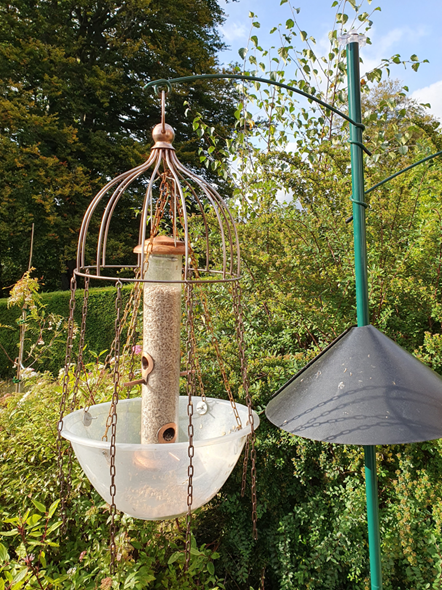
The feeder at the back had the same unwanted wildlife problem but its mechanics were different. Instead of hanging from a hook at the end of an arm of the upright feeder station pole, the feeder was screwed onto the top of the pole. No arms and hooks, so nothing to hang the bowl from. That’s where the commercial squirrel guard I mentioned earlier came to the rescue. I bought two, one to be used as a squirrel guard (like an inverted bowl) and one above it the other way up to catch the seeds. That worked like a charm too.
Except we haven’t found a solution for feeding the gluttonous pigeons. They worked out that they can stand on the edge of the top bowl, strain their neck a bit and reach the bottom seed hole in the feeder. And you can imagine how quickly the feeder gets emptied. Also, this bowl is big enough and unencumbered by chains that they can stand in it and eat the residue (that’s not so bad, given the wastage anyway). Lowering the bowls on the pole helps but raises the risk of the discarded seeds missing. More work in progress.

I’m pleased to report that Plan B was never seriously implemented because Plan A worked so well. Plan B did have two options. We looked into getting an air rifle, but Scotland, unlike England, has treated air pistols and air rifles as lethal weapons after the Dunblane school incident, so it was going to be a lot of hassle just owning one, never mind actually hitting the intended target.
The second option was the easier to implement. I bought a couple of poison dispensers that I put in the garden where the rats had been seen running, and soon after I saw a rat showing signs of having eaten some. Nothing since. My friend Gordon told me rats were neophobic – they’re creatures of habit and eschew new things (which could include poison dispensers appearing on their runs), so I wasn’t too hopeful. I didn’t check the dispensers until August, but they were empty, so something didn’t feel very well. They’re in the garage now.
For the rest of the summer, we got immense pleasure from watching the birds at the feeders. Hopefully the birds, and later their young, appreciated the efforts we went to in order to keep the restaurant open. And another autumn is upon us and they’re going to want three square a day again.
I continue to make modifications to the feeder stations given the new balcony which now obstructs the view of the front garden feeder and the fact one of the expensive squirrel guard bowls cracked and broke – probably the weight of a fat pigeon was too much for it. You’ll be pleased to know that another hardware bowl at a fraction of the price has been modified to do the same job. It’s the old story of Once You Start …….


Don’t envy you the rats, although I know they are about her- but no mention of our two favourite pests: squirrels and pigeons! They hoover up most of the debris as well as most of the food
LikeLike
I enjoyed all the various bird character descriptions Peter! Very clever. But I have to take issue with you about rats… I like them! 🙂
LikeLike
Well, interesting read and good you resolved how to feed the birds economically but sad that any ground feeder now has to starve.
Sadly for the Rat, (Norveticus Norveticus), it has got a bad press ever since it was implicated in carrying the plague, when in fact it was the flea carrying Yersinia Pestis, a bacterium that caused disease. Rats are very clean animals. During the pandemic of plague, ships from the orient visiting Italy had to anchor offshore for forty days (Quattro) so rats would not get ashore. Hence the origin of quarantine (Quattro).
Just as interesting in you brief thesis on bird behaviour which I liked, as I too observe different behaviours of visitors to my pathetic bird feeder (compared to your state of the art one). In the main I agree with your observations however I suspect coal tits to return frequently to stash the sunflower seeds for later? Other birds discard the husks during the eating process.
I understand people are phobic about rats and had to laugh at your mention of tough Glaswegians being scared? Tough my aunt fanny! I could go on about people and refuse which only encourage rats and others but there’s nowt as strange as folk!
PS skipped the Belbin bit!
What’s in store next?
LikeLike