9th and 10th September 2023
Having a dog is a great way to get some exercise, but it really helps if somebody else picks up. I have that happy arrangement – Ernie is Sabine’s Chihuahua, she has total responsibility for that side of things and I don’t interfere. Sharing is what it’s all about. She shares him with her ex, Ian, and when Ernie comes to stay, I share Sabine with him.
Sabine fetched him on Friday morning with the intention that he would return to his main home on Saturday, but Ian came down with a late summer cold, so we got to keep Ernie for another day. Saturday was amazingly hot and dry in Rhu (an almost unheard of 26C), so we took him for an earlyish (for us) morning walk around Ardmore Point, a favourite of ours. It’s about 4 miles east of us, through Helensburgh towards Cardross, jutting out into the River Clyde.
The walk is around the outside edge of the point. We’d tried to cut across it once for a bit of variety and regretted it. The path that we took went through some woods and, just as we got to what we judged was the point of no return, disappeared. We then had to bushwack our way around thickets of rhododendrons and the tangled brambles, over fallen trees and through very muddy bog-like patches until we reached the track to the big house on the Point, whereupon we had to climb over a barbed wire fence to access the track. We haven’t tried that route again.
So this Saturday I only took my binoculars, reckoning on a more sedentary walk, which we had. I had the telescope in the car too, but the bay by the carpark was devoid of bird life, and in any case I wasn’t going to take it all the way round for two good reasons – it’s quite heavy despite having a special backpack for it and it would take too long to keep setting it up with Ernie in tow.
As we left the carpark some campers had started up their gas stove and were cooking breakfast. We got a whiff from it that drifted across to us – what is it about other people’s outdoor cooking that smells so good and makes you feel so hungry?
The first part of the walk if you go anti-clockwise, which we usually do for some reason, takes you down to another bay and then the path goes left around the Point. We noticed a few things as we went on this stretch. The first was that you really needed to watch where you trod. Clearly other people don’t have the same happy arrangement that Sabine and I have in sharing dog responsibilities when it comes to their dogs.
The path had dog pooh in too many places probably at the start of the doggy walk, if Ernie is anything to go by, and their foul owners weren’t doing their end of the business. One was deposited exactly mid-point across the path and I could imagine the animal getting a treat for being some precise.
Anyway, let’s not ruin a perfectly lovely morning with that memory. It did get better – as I said, they probably got it out of the way early on, but I was a bit more careful towards the end of the walk too just in case the same applied to the clockwise dog walks.
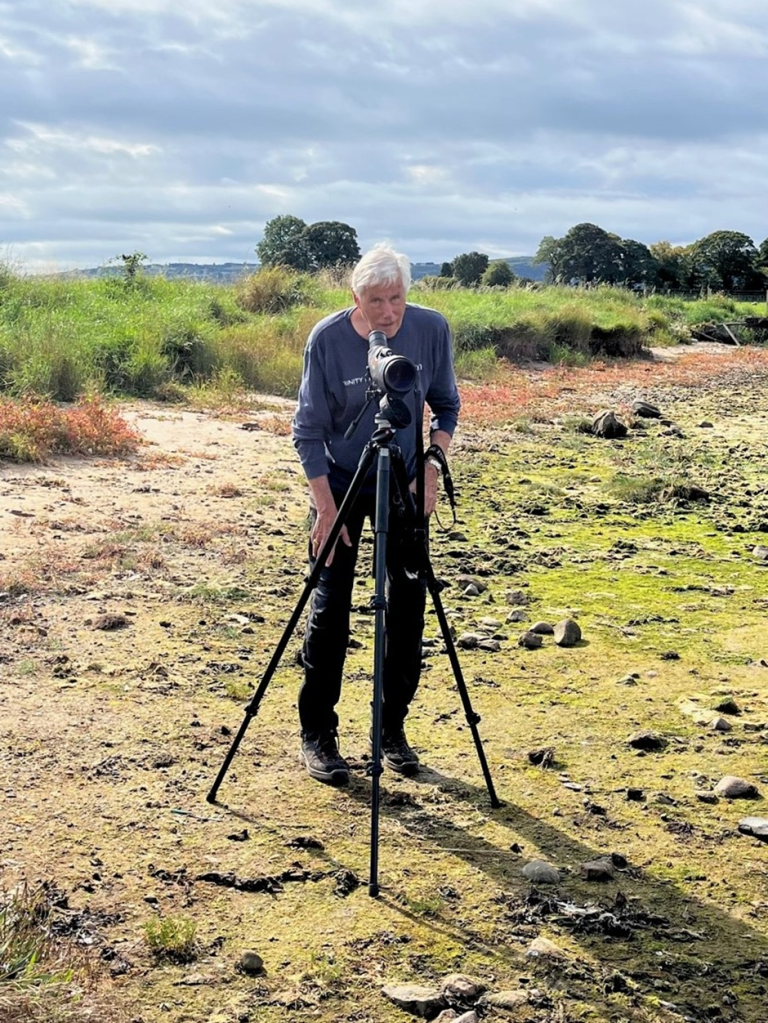
Where the path turned left, we met a man coming from a less used path to the right who was carrying a telescope attached to a tripod. There were a lot of shorebirds out on the mudflats of the bay where the tide was neither high nor low. The sea can go out quite a distance at low tide, which would be too far to see much clearly, even with a telescope, but this midpoint seemed ok.
I hate being asked if I’ve seen anything interesting because inevitably I haven’t and the person asking clearly thinks that the only birds that matter are ones of some particular rarity. So while I was dying to know what he’d seen, I wasn’t going to ask him, and I got a bit concerned as I heard Sabine say Hello in the friendly way that indicates a question would follow.
But bless her, she asked if he’d seen a LOT of birds, which gave him the chance to tell us that there were quite a few of waders out there but too far away for him to identify too many of them (despite the telescope?) and that there was a peregrine around. Later in the walk, as I scanned the sky hopefully but fruitlessly, I reflected on the peregrine information, and realised that he probably hadn’t seen the bird, just read about it on a local on-line “who’s seen what” birding sites.
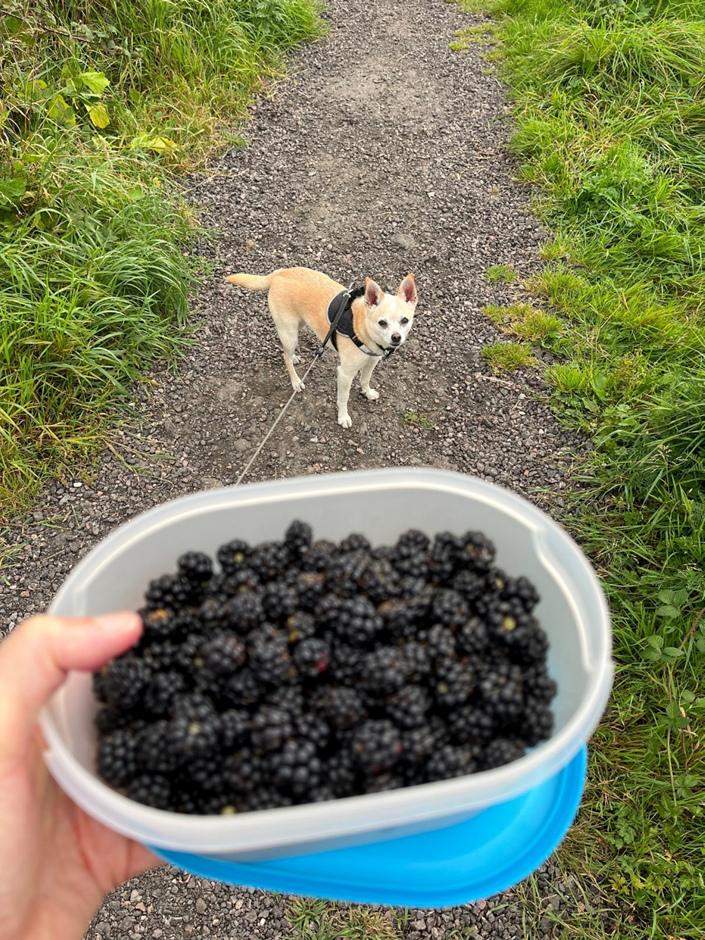
Immediately after the birder, at the same place, coming from the opposite (left) direction, we met another man and his dog picking blackberries (not the dog obviously). He was very enthusiastic and said there were loads to be had, particularly further round. He even offered us some from his stash. Sabine asked him what he would do with them and he said he was looking forward to making blackberry and apple crumble, one of my signature dishes. It was only later that I realised I’d missed the opportunity to swap crumble recipes with him – I always use Delia’s with nuts.
We walked all the way round, noting a lot of places for blackberry picking. The early fog had cleared enough at the start of the walk, but it carried on getting brighter. There was no wind, so the Clyde was like glass, making it easier to see the seabirds out there – eiders, with the males either in or turning into their beautiful breeding plumage, with the females being followed by what I think were 3 or 4 ducklings, about 50 red-breasted mergansers swimming in a straight line from left to right, 2 great crested grebes swimming in the opposite directions, lots of cormorants and gulls and, too far out to be certain, black guillemots. Towards the end of the walk, we had the pleasure of a grey seal’s company.
The seal appeared just after we’d said Hello to a middle-aged couple who were looking at his phone at the side of the path in an enquiring sort of way which implied they weren’t sure where they were. Sure enough they were trying to judge how long the walk was from Google Maps. Sabine told them it was about half an hour which I thought was on the thin side. It is in fact just under 2 miles. The time it took us was nothing to go by because we kept stopping for me to look at birds and for Ernie to sniff God knows what.
The lady’s English accent made Sabine ask if they were German, which they were, so they continued the conversation in that language. They were camping, and were planning to visit Geilston and Hill House gardens, both nearby, that day. She thought that they might be doing enough walking without anything extra like Ardmore Point. We left them pondering but then saw them several times more.
We walked on, stopped again to look at birds and the Germans passed us, having apparently decided the walk looked more than they wanted to do and turned back. A little further on, we passed them again. Poor people had made the mistake of getting into a conversation with a man with two dogs, one a spaniel and one an Italian greyhound, a fact that was gleaned by Sabine asking if it was a Whippet. When she said it was big for an Italian greyhound, he bristled and said it was fully grown and wouldn’t be getting any bigger. I can’t imagine what he had to say to the German couple that took so long but he sure was doing all the talking. He left us both with the impression of being your worst nightmare at a dinner party.
I hadn’t actually spoken to the Germans but as we went between them and the talkative man, I wished them “Schöne Wochenende” which, by the way she said “Danke”, had pleasantly surprised her. I wasn’t sure I’d got the adjective ending right though, so I checked with Sabine who told me it should have been “Schönes” because it was “das Wochenende”. Of course …. what a dummkopf.
At the car, having extracted themselves from said man, they passed us for the last time on the way to their large campervan (camping, eh?) and she wished us “Schönes Wochenende”. I’m sure there was a little stress on the “es” for my benefit. I think she must be a teacher.
We had had such a lovely walk that we decided to go back the next day. I’d do some birdwatching in the first bay with the telescope and Sabine would take a container and pick blackberries with Ernie. The tide would be about 40 minutes different, but that would be fine as we could still watch Laura Kuenssberg. Fortunately her over-aggressive and unproductive interviewing style and the fact that an unshaven Stephen Fry who Sabine can’t stand was on the panel meant that we only watched about half the show.
I say fortunately because I wanted the tide to be roughly where it was the day before so the birds wouldn’t be too far out or not able to feed because the tide was too far in, and it was. It wasn’t as nice a day but promised to get better and the sea state was the same, flat calm, as the day before.

We started down the same anticlockwise track. Ernie obliged almost immediately and Sabine went back to drop the bag by the car, thoughtfully preferring not to be incumbered by it while picking blackberries. Sure enough, we quickly came across fresh signs of other dogs being taken for walks by owners without the same level of social integration.
After one particularly large example, a couple appeared going the other way with two collies and I noticed they didn’t have a pooh bag between them (unless the woman had put them in her bum bag – pardon the pun), so I was left wondering why that would be and hoping I hadn’t inadvertently trodden in one possibility.
We’d started picking blackberries on the way to the bay where the path goes left for around the Point or right for birds. There, we separated after finding that the guy the day before had generously left quite a lot of blackberries for us. Rich pickings. I walked along the uneven path by a fence line on my right with long grass and the bay to my right, and a lot of shorebirds in the distance ahead of me.
There were texel sheep in the field to my right (undoubtedly the ugliest breed of any domesticated animal) and one of them had put its head through the wire chain link fencing to get at the long grass. I groaned in anticipation of having to help it extract itself, sheep being driven, according to Sabine’s brother, by a self-destruct gene, but it managed to free itself on its own with a twist of the head that indicated a certain practised familiarity with the situation.
Apologies if you don’t like birds, birdwatching and/or birders – the rest of the story revolves around all three. But if you’ve got this far, you’ve already put up with dog pooh and what follows is a lot better than that.
On I went. As I walked along the narrow grassy path, I thought a good vantage point would be over to my left where a small piece of land jutted out into the bay. It would be far enough away not to scare the birds to flight. The land in between was covered with long grass and, about 10 feet off the path, my right leg went all the way down into a hole that I couldn’t see. There were probably a lot more holes hidden by the grass. Not a good idea, Peter. I managed to extract my leg, unbroken and still attached, and gingerly wended my way back to the safety of the path. Won’t be doing that again!
Back to Plan A – walk along the path as far as I could, step onto the beach and position myself on another low promontory, hopefully still far enough away not to spook the birds. I needn’t have worried. It was a perfect spot and I was able to set up the tripod and telescope behind the low rise of the land to act as a little cover from the large flock of waders, ducks, and gulls ahead of me.
No sooner had I had a first peek through the telescope than I was joined by another birder, also with a tripod and telescope. She looked late 30s but had grey hair. She asked if I minded her using the same spot and of course I replied positively, saying four eyes were better than two. I soon found out that her eyes were an awful lot better than mine in finding and identifying the variety of birds that were in front of us. From my point of view, this could not have turned out to be a better morning.
Just a word on my use of capitals when naming bird species. I haven’t used them if the term is generic, as above (waders, ducks and gulls), but when it’s a specific species (e.g. Herring Gull), I’ve used them to help those readers less familiar with the terms to make the distinction.
Feeling that if we were to establish any kind of rapport, I needed to get awkward things out in the open as soon as possible. I told her I was pretty rubbish at identifying waders. Don’t worry, she said, she’s pretty good at it as she loves the challenge they present. Wow! My day was going from great to fantastic!
The first thing she did was identify a Greenshank that I would have completely missed – I struggled to find it to begin with in my telescope even when she told me where it was. It was among some Common Gulls and some Curlew. She had it in her scope and we swapped scopes so I could see it. Shannon (we’d introduced ourselves by then) gave an exclamation of appreciation as she saw how clear the birds were in my Swarovski telescope, which was lovely because I didn’t feel I was going to contribute very much else to our joint birding experience. Swarovski is the market leader, expensive but extraordinary – it took me decades (till lockdown actually) to persuade myself I really should get one, a decision made easier by my old telescope giving up the ghost.
But I sell myself a little short in the morning’s activity . Mainly thanks to the telescope, I was able to find birds that Shannon hadn’t seen (yet) – but she still very kindly would identify them if I wasn’t sure what they were. Not just that, but she gave tips as to why the bird was what it was – e.g. less spangled on the back than a similar species, slight upward bill, colour of the legs, size.
With Shannon’s help, I saw four birds I hadn’t seen this year (and in fact which I rarely see most years) – yes, sorry, I’m one of those sad people who need to have a spreadsheet list each year that shows me what I’ve seen and of course the total for each year. I can tell Sabine worries about my sanity while at the same giving herself great pleasure relaying this need to anyone who shows even just a vague interest in my hobby.
However, that’s nothing on Shannon. She not only records what she’s seen but counts how many of each species, and then fills out an on-line record for the British Trust for Ornithology using their app Birdtrack. As I looked through the telescope at the untold numbers of Curlew and thinking about the murmurations of starlings that are a feature of the autumn evening sky, for example, I know how committed Shannon must be. One serious birder!
One of those four birds for me was the Greenshank, a pair in fact, which had its bill tucked in under its wing in the classic resting position of so many waders when Shannon spotted it. It makes them a lot harder to identify as the shape and length of the bill is often a strong identifier, you couldn’t see its green legs either and it was quite a long way off, so her correct diagnosis was quite amazing. I returned to it later and it obliged me by moving so I got to properly see its bill, its long green legs and the pattern of its plumage – tick!
Another one was the Black-tailed Godwit, easily confused with the Bar-tailed Godwit, both of which were present in the Bay that morning. Sabine and I had seen the Bar-tailed the day before, and as the Black-tailed is less common, it was another special find by my new best birding buddy. She followed it up by finding a pair of Knot (bird #3), small waders often seen in large flocks of hundreds. Once you have them pointed out, they’re obvious, but how Shannon saw them in the first place was amazing, as they were standing a way off among a group of much larger Curlews. My scope came in handy again.
Other waders were the enduring and omnipresent Oystercatcher, lots of Redshank, a few Dunlin, a flock of Lapwing and three Snipe. Shannon mentioned seeing a Little Ringer Plover but I never espied it. The important things are patience and going back and forth over the same ground because these birds can easily disappear from view and reappear somewhere else depending on the terrain.
Gulls come in different shapes and sizes and that morning we had all the main ones – Great and Lesser Black-backed, Herring, Common and Black-headed (which lose their black heads in winter). There were two Little Egret there too. And although not actually gulls, I’d seen a pair of Gannets at the Point the day before.
I actually found the Pintail on my own (#4, a duck), but couldn’t tell what it was as it was in its eclipse plumage which I’d never seen before. Male ducks in non-breeding plumage often look a little drab and nothing like as striking as they do in their breeding plumage, which changes about now ready for the winter pairing and spring mating. So oddly, it’s in the winter that male ducks are prettier and easier to identify.
However about now they are in transition, some still in eclipse, some in their breeding plumage, and some in between, which makes identification more than a challenge. Waders are in a similar state of plumage, except they are going in the opposite direction, changing from breeding to the duller winter plumage. While asking Shannon about the Pintail, she was able to show me the Wigeon in its deep chestnut eclipse coat in the same scope view. The Canada Geese, Shelduck, Teal, the Eider and the same fifty Red-breasted Mergansers out in the bay, and the inevitable Mallard were very straightforward for me, though.
Sometime while all this was going on, I asked Shannon what she did when she wasn’t bird recording. She worked at Glasgow University, doing administration. It turned out that she worked in the same College of Art as Sabine whose name rang a bell – she’d not met her but had worked on a grant application for her.
Towards the end of this enjoyable morning distraction, Sabine and Ernie appeared, blackberries having been picked and Ernie having been walked, so the two were able to say Hello. Yes, their paths had crossed albeit remotely. Small world, even here, eh? Shannon is taking a new role in a different part of the university, though, so they may not be able to work together again.
Shannon wasn’t finished helping Sabine though. Sabine was sufficiently interested in what we had seen to push me out of the way to look at the birds through the telescope. Sabine asked a question which Shannon answered, whereupon I stood well back while Shannon took on the role of guide and teacher. She walked Sabine through some of the ducks she could see and explained the differences between three species of wader standing together – Curlew (big), Bar-tailed Godwit (medium) and Knot (small). Examples of these birds were together in the same scope view so it was easy for Sabine to get an appreciation of their relative sizes, bills and colouring.
We reluctantly said goodbye to Shannon and the birds. Treading carefully on the path, we reached the car with incident. Sabine said Ernie’s pooh bag had gone – how nice of someone to have picked it up and put in the bin. I suggested it could have been the pair we’d seen at the start of our walk – they might have thought they could avoid criticism if they were seen to put one in the bin.
 Pete's Perusings
Enjoyed that Peter! Clare x
LikeLike
Thank you so much, Clare. X
LikeLike
We could all write a book about dogs and their owners with respect to pooh, however despite your observations re the latter, I really enjoyed hearing about the variety of birds (some I haven’t ticked) and finding a nice spot to birdwatch. Keep on birding. 🦤
LikeLike