- Cape Mountain Zebra
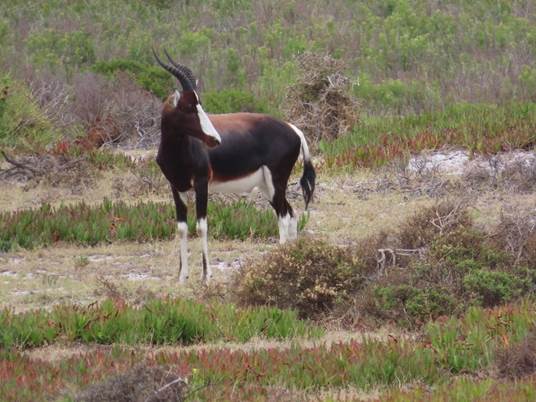
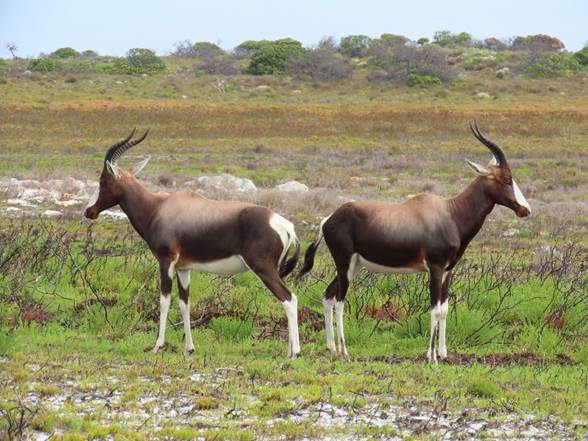
Now we really came into our own in Dominic’s eyes. We were at the end of the day’s tour, on a road running next to the Nature Reserve delimited by a fence on our left with scrubland beyond. We noticed some bontebok grazing. Then Sabine said – Oh, is that a zebra with them? – followed by screeching brakes and an emergency stop. Dominic got all excited once again – a rare Cape Mountain Zebra that he hardly ever sees, conservation status Vulnerable.
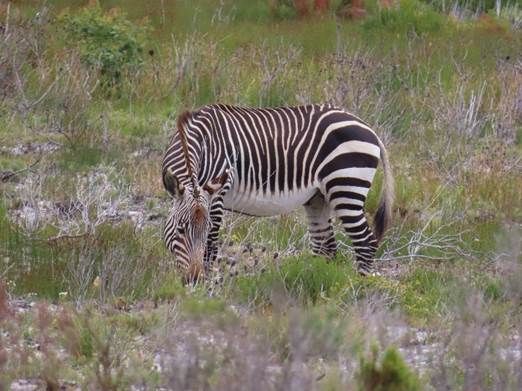
It’s the smallest zebra species with narrower and more numerous vertical stripes and wider horizontal strips on the hind quarters. It is only found in the Cape Province, historically the most populated region of South Africa and hence hunted virtually to extinction by the early settlers.
- Quagga
It seems only fitting to next show you the other zebra we saw, this one on the Idiom Nature Reserve attached to the winery and restaurant, owned by one of Sabine’s Summer School “students” and her husband.
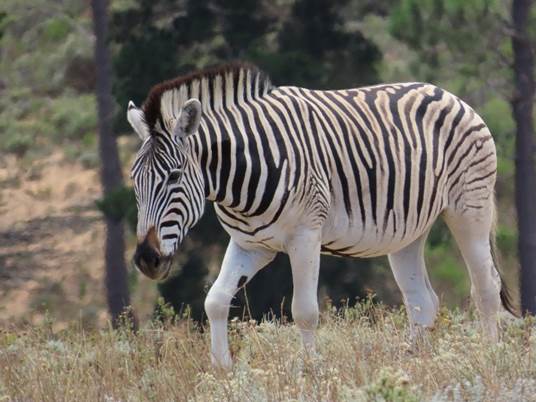

This breed is actually extinct (in the wild by 1878 and in captivity five years later) but advances in genetics and breeding techniques have spawned a project to bring the species back to life. But not everyone is enthusiastic about it:
The debate seems to centre around two things – whether it was ever a separate species and the use of a strain of plains zebras that had similar markings to bring it back to life. You can easily spot that the rear is very different from the markings of both the Cape Mountain Zebra and the regular plains zebras below that we saw a lot in Kenya. But if you click on the Wikipedia link, you’ll see that it doesn’t look much like the 1870 photo of the one held in London Zoo. I’m no expert of course but I must admit that I think the shape of the new ones looks very much like that of the plains zebra (collective noun: a dazzle 😊).

- Springbok
Less controversial is the little antelope that the national rugby team is named after. We saw them in the Idiom reserve alongside the quagga. South Africa has a lot of antelope of different sizes and camouflage patterns. In the bush, they are fearful of predators (one ranger described them as Fast Food). To say that, generally, antelope in the wild are always on edge is to put it mildly and for good reason, given that our group actually witnessed 9 female lions kill an impala in Kruger what is now 15 years ago.
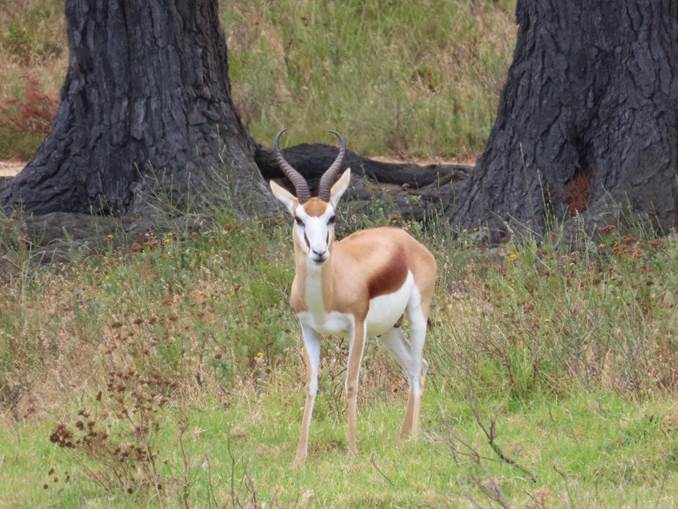
The Springbok we saw here were a lot less nervous, probably given that the reserve didn’t boast the predators of the wild, and I have to say they are probably the prettiest of all the antelopes I’ve seen in Africa.
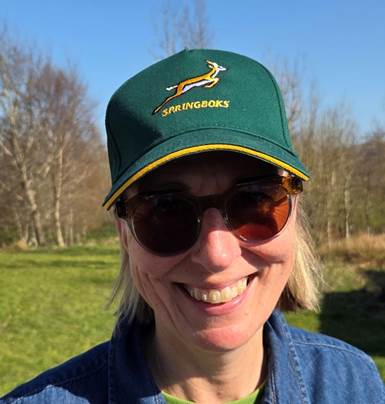
And talking of pretty, here’s the rugby team’s emblem, modelled by Sabine.
- Cape Dwarf Chamaeleon
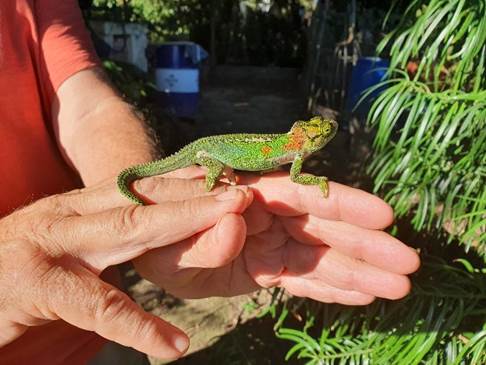
We were in the David the potter’s garden in Swellendam with Garth’s birding friends when Kevin, one half of this couple, suddenly had this chameleon on his hand. He’d seen it in the bush (also in the photo) and had grabbed it to show us. Quite amazing. Presumably if he’d held on to it for much longer, it would have changed colour to pink to blend in with his hand.
They are found only in the southwestern Cape around Cape Town. They are insectivorous and, while very slow moving, catch their prey with a very fast moving tongue. Interestingly, their eyes can move independently of one other.
- Cape Fur Seal
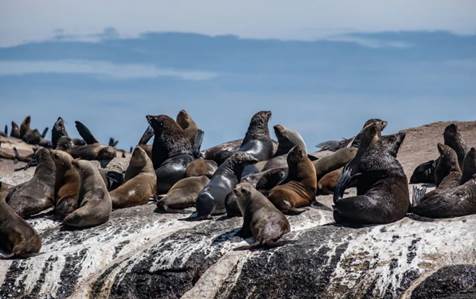
I wasn’t that interested in them (hence this isn’t my photo) – there were birds on the shore that I wanted to see, the seals were just lying around all cuddled up or maybe going for a swim and were a bit comical trying to move around on land on their tummies. And in any case, I’d seen grey and common seals in the Murray Firth.
But Dominic gave us some information about them that was a bit unusual. First their numbers have soared recently because of orcas predating the great white sharks that in turn preyed on them. The sharks have all but disappeared from False Bay where a lot of the Cape Fur Seals live, so they have no natural predators. However, Mother Nature loves things to be in balance and after it was noticed that the seals have been behaving more aggressively, it turned out that they now have rabies, contracted possibly from a seal being bitten by a jackal. Swim at your own risk.
- Mongoose
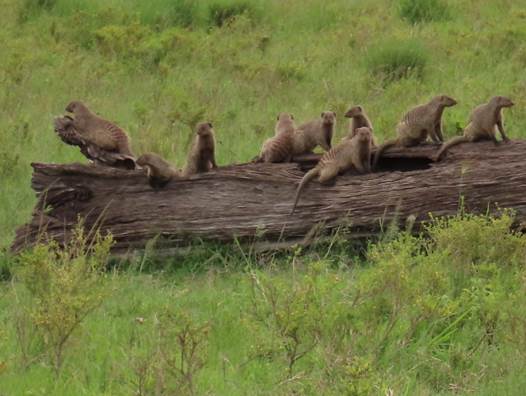
We only saw one fleetingly on the walking bird tour morning with Lynette, so here’s a photo of a mob of them we saw in Kenya (plural mongooses, not mongeese, other collective nouns being pack, troop, gang). These ones are banded mongooses, but while the one we glimpsed outside Outshoorn could have been the same, other options include the Cape Grey, Slender, and Yellow.
- Vervet Monkey
We were on a nature trail in Wildness (now misnamed as it is anything but wild in the most part – very touristy and built-up in the narrow strip between the Indian Ocean and the lakes at the foot of an escarpment. Cutting into this ridge was the nature trail we were on, a valley lengthways like a Y made by a couple of streams coming together.
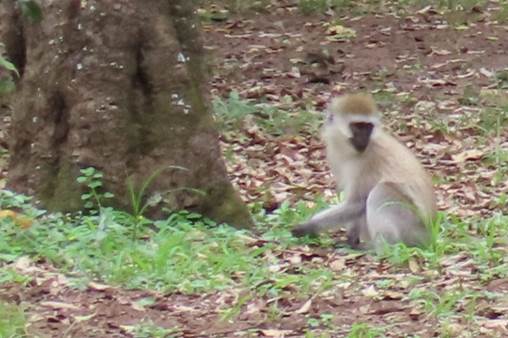
Sabine saw it first, about 3 metres up on a branch in a dense foliage – hence no photo. It was quite shy, seemingly not afraid of humans in that it didn’t disappear into the undergrowth but sat looking at us. So we got a good look at it. In fact we saw two of them during the walk, both totally uncooperative when it came to having their photo taken, so here is one from Kenya.
- Dolphin
On our last Sunday, we were invited to lunch by David, another of Sabine’s “students”, a GP who after retiring at the tender age of 53 went to Canada with his wife and undertook a series of 2 year-long locum roles all over the country including Haida Gwaii in northern BC and First Nations land, and also Churchill, Manitoba where Inuit were his patients – hence his interest in Sabine’s course. He and his wife have only just returned to Cape Town – in their time in Canada they have seen more of that vast country than any Canadian I know. Theirs is one of those fascinating life stories I mentioned in the previous story “What a surprise”.
Anyway, lunch was at the waterfront Radisson in sight of Robin Island and to our delight a pod of dolphins swam past while we were there. What kind they were I have no idea – Bottlenose or Heaviside’s, Common or Humpback are the four options, but in reality it simply felt like a privilege to see them glide by so gracefully and silently close to where we were sitting.
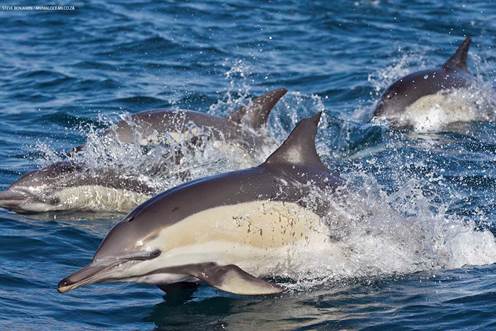
Common Dolphins
And that completes the list of the non-bird wildlife we saw in our January/February 2025 trip. It was a trip experience bonus added to the lovely people we met, to Sabine’s lectures and the “student” appreciation she received, to Cape Town and the parts of the Garden Route we visited and to the birds we saw (their story is next).


 Pete's Perusings