Tag Archives: africa

Western Cape Wildlife – Part 2

  • Cape Mountain Zebra

Now we really came into our own in Dominic’s eyes.  We were at the end of the day’s tour, on a road running next to the Nature Reserve delimited by a fence on our left with scrubland beyond.  We noticed some bontebok grazing.  Then Sabine said – Oh, is that a zebra with them? – followed by  screeching brakes and an emergency stop.  Dominic got all excited once again – a rare Cape Mountain Zebra that he hardly ever sees, conservation status Vulnerable. 
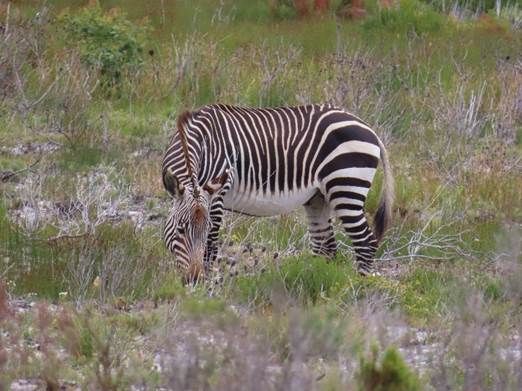
It’s the smallest zebra species with narrower and more numerous vertical stripes and wider horizontal strips on the hind quarters.  It is only found in the Cape Province, historically the most populated region of South Africa and hence hunted virtually to extinction by the early settlers.

  • Quagga

It seems only fitting to next show you the other zebra we saw, this one on the Idiom Nature Reserve attached to the winery and restaurant, owned by one of Sabine’s Summer School “students” and her husband. 
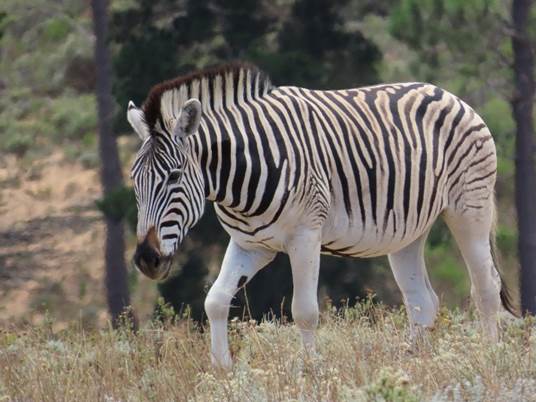
This breed is actually extinct (in the wild by 1878 and in captivity five years later) but advances in genetics and breeding techniques have spawned a project to bring the species back to life.  But not everyone is enthusiastic about it:

https://nypost.com/2024/11/11/science/scientists-divided-over-resurrection-of-extinct-quagga-species/

https://en.wikipedia.org/wiki/Quagga#:~:text=The%20last%20wild%20population%20lived,animal%20whose%20DNA%20was%20analysed

The debate seems to centre around two things – whether it was ever a separate species and the use of a strain of plains zebras that had similar markings to bring it back to life.  You can easily spot that the rear is very different from the markings of both the Cape Mountain Zebra and the regular plains zebras below that we saw a lot in Kenya.  But if you click on the Wikipedia link, you’ll see that it doesn’t look much like the 1870 photo of the one held in London Zoo.  I’m no expert of course but I must admit that I think the shape of the new ones looks very much like that of the plains zebra (collective noun: a dazzle 😊).

  • Springbok

Less controversial is the little antelope that the national rugby team is named after.  We saw them in the Idiom reserve alongside the quagga.  South Africa has a lot of antelope of different sizes and camouflage patterns.  In the bush, they are fearful of predators (one ranger described them as Fast Food).  To say that, generally, antelope in the wild are always on edge is to put it mildly and for good reason, given that our group actually witnessed 9 female lions kill an impala in Kruger what is now 15 years ago. 
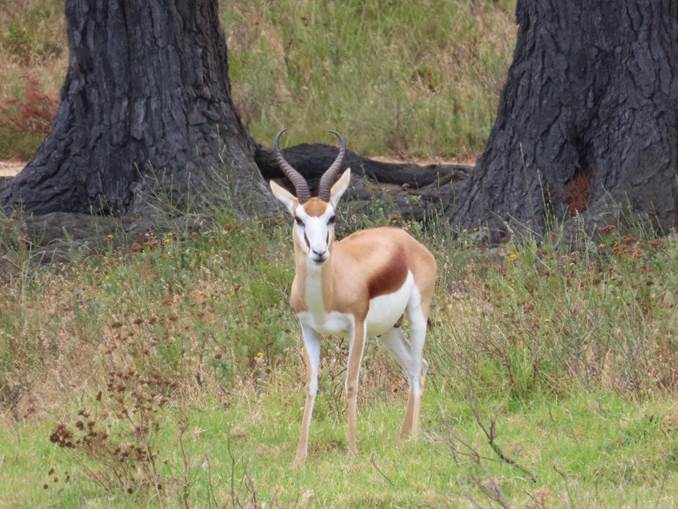
The Springbok we saw here were a lot less nervous, probably given that the reserve didn’t boast the predators of the wild, and I have to say they are probably the prettiest of all the antelopes I’ve seen in Africa.
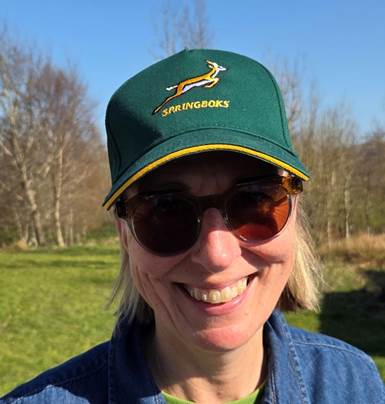
And talking of pretty, here’s the rugby team’s emblem, modelled by Sabine.

  • Cape Dwarf Chamaeleon

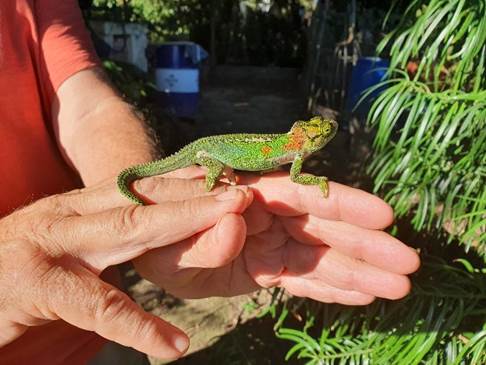
We were in the David the potter’s garden in Swellendam with Garth’s birding friends when Kevin, one half of this couple, suddenly had this chameleon on his hand.  He’d seen it in the bush (also in the photo) and had grabbed it to show us.  Quite amazing.  Presumably if he’d held on to it for much longer, it would have changed colour to pink to blend in with his hand.

They are found only in the southwestern Cape around Cape Town.  They are insectivorous and, while very slow moving, catch their prey with a very fast moving tongue.  Interestingly, their eyes can move independently of one other.

  • Cape Fur Seal

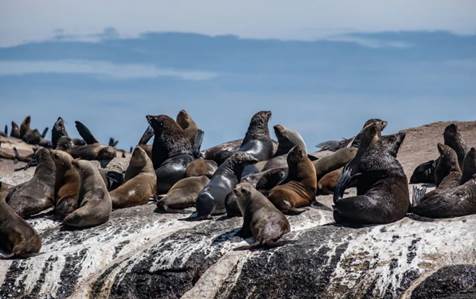
I wasn’t that interested in them (hence this isn’t my photo) – there were birds on the shore that I wanted to see, the seals were just lying around all cuddled up or maybe going for a swim and were a bit comical trying to move around on land on their tummies.   And in any case, I’d seen grey and common seals in the Murray Firth. 

But Dominic gave us some information about them that was a bit unusual.  First their numbers have soared recently because of orcas predating the great white sharks that in turn preyed on them.  The sharks have all but disappeared from False Bay where a lot of the Cape Fur Seals live, so they have no natural predators.  However, Mother Nature loves things to be in balance and after it was noticed that the seals have been behaving more aggressively, it turned out that they now have rabies, contracted possibly from a seal being bitten by a jackal.  Swim at your own risk.

  • Mongoose

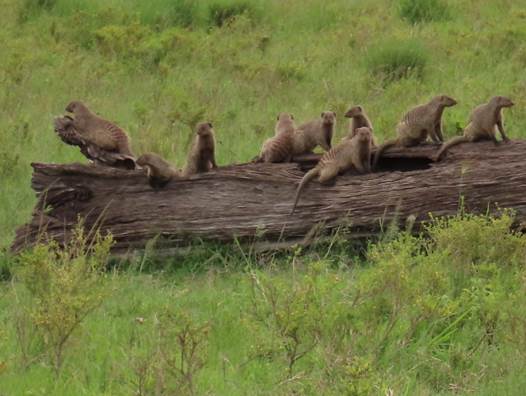
We only saw one fleetingly on the walking bird tour morning with Lynette, so here’s a photo of a mob of them we saw in Kenya (plural mongooses, not mongeese, other collective nouns being pack, troop, gang).  These ones are banded mongooses, but while the one we glimpsed outside Outshoorn could have been the same, other options include the Cape Grey, Slender, and Yellow.

  • Vervet Monkey

We were on a nature trail in Wildness (now misnamed as it is anything but wild in the most part – very touristy and built-up in the narrow strip between the Indian Ocean and the lakes at the foot of an escarpment.  Cutting into this ridge was the nature trail we were on, a valley lengthways like a Y made by a couple of streams coming together.

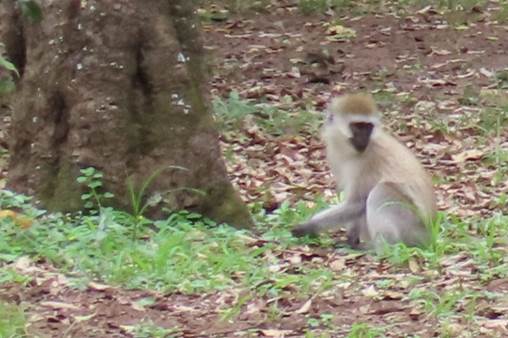
Sabine saw it first, about 3 metres up on a branch in a dense foliage – hence no photo.  It was quite shy, seemingly not afraid of humans in that it didn’t disappear into the undergrowth but sat looking at us.  So we got a good look at it.  In fact we saw two of them during the walk, both totally uncooperative when it came to having their photo taken, so here is one from Kenya.
  • Dolphin

On our last Sunday, we were invited to lunch by David, another of Sabine’s “students”, a GP who after retiring at the tender age of 53 went to Canada with his wife and undertook a series of 2 year-long locum roles all over the country including Haida Gwaii in northern BC and First Nations land, and also Churchill, Manitoba where Inuit were his patients – hence his interest in Sabine’s course.  He and his wife have only just returned to Cape Town – in their time in Canada they have seen more of that vast country than any Canadian I know.  Theirs is one of those fascinating life stories I mentioned in the previous story “What a surprise”.

Anyway, lunch was at the waterfront Radisson in sight of Robin Island and to our delight a pod of dolphins swam past while we were there.  What kind they were I have no idea – Bottlenose or Heaviside’s, Common or Humpback are the four options, but in reality it simply felt like a privilege to see them glide by so gracefully and silently close to where we were sitting.
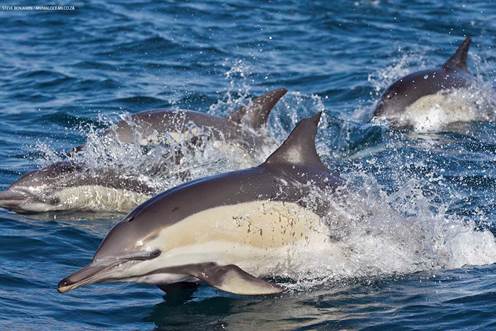
Common Dolphins

And that completes the list of the non-bird wildlife we saw in our January/February 2025 trip.  It was a trip experience bonus added to the lovely people we met, to Sabine’s lectures and the “student” appreciation she received, to Cape Town and the parts of the Garden Route we visited and to the birds we saw (their story is next).
Western Cape Wildlife – Part 1

I’ve had to split this story in two – too much to say in one post.  This trip wasn’t meant to include a safari of any kind, but we did manage to arrange some birding day or part-day tours that brought us close to non-bird wildlife.  Here’s what we saw.  What struck me was the variety and also how much depended on luck – seeing most of the animals was random, the luck of the draw, completely unplanned (just like birds).   I’d never heard of a lot of them, so I’m guessing neither have most of you.  Each in their own way were quite special.

About half of them we saw with Dominic, the Fynbos (pronounced Fainboss) Guy on the two one-day tours in Cape Town and in the Cape Point Nature Reserve.  Despite being British, he was very knowledgeable – he came out when he was 19, and started off guiding for safari lodges in Botswana before moving south and setting up his own business.  Each day was different and fantastic.  The other main exposure we had to non-bird wildlife was with Andrew, the ranger at the Idiom Winery Nature Reserve, who took us for an hour’s game drive.

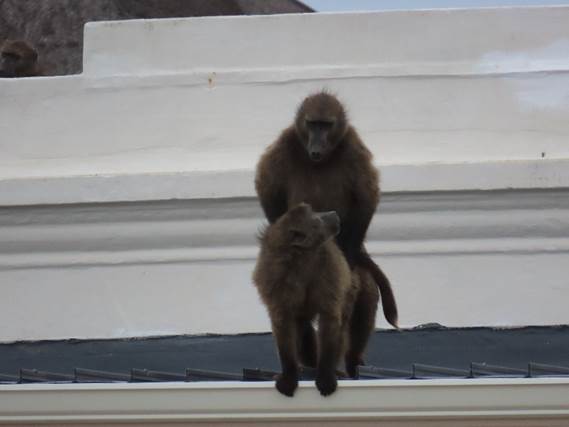
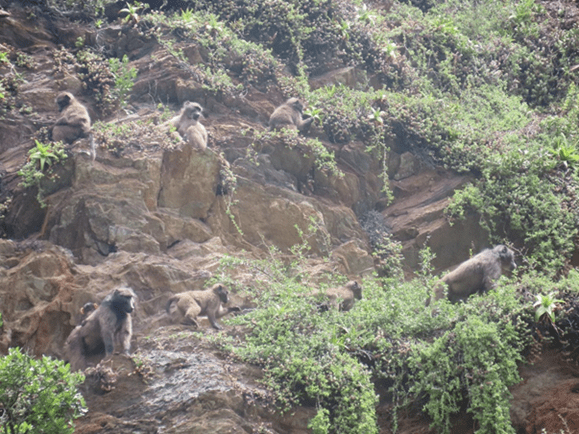
  • Baboon

Baboons were everywhere and have become an urban pest.

This might be why there are so many of them 😊

And this is more like where they belong

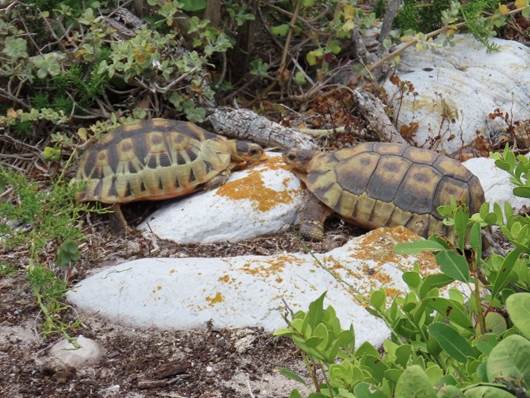
  • Angulate Tortoise

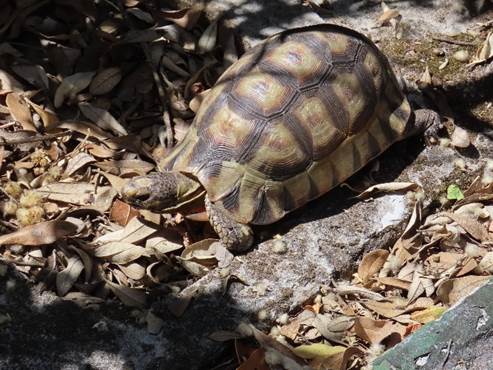
We came across them in two locations and their conservation category is Least Concern.  Contrary to a tortoise’s reputation, they can move quite quickly when they want to and they are easily camouflaged in the undergrowth.  They’re very territorial and in the bottom photo, two males are facing off – the one on the right came out on top.

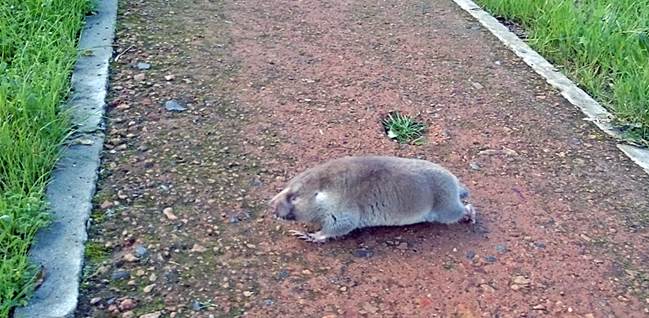
  • Cape Dune Mole-rat

We’d only just been talking about moles and mole-rats when Dominic spotted a mole-rat by the side of the track at the sewage works.  It scampered away from us as we went to get a closer look, so this is a picture taken by someone’s camera trap.  Dominic was very excited because you don’t usually see them in daylight as they live most of their lives in burrows in sandy soil.  He said it was either ill or looking for a mate and it didn’t look ill.  They’re fat and ugly with projecting pairs of top and bottom teeth – being mostly blind, presumably looks aren’t important to other dune mole-rats.

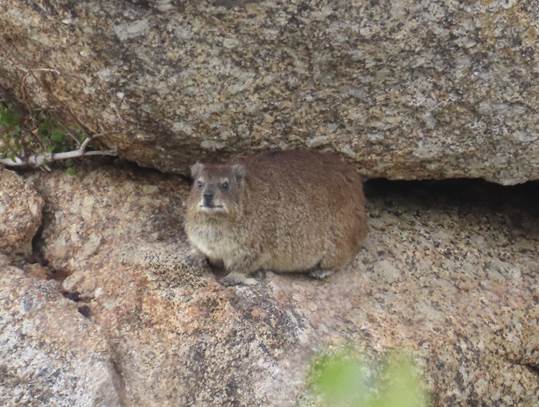
  • Dassie

We saw several dassies on Boulders Beach, Simonstown in the same area as the penguins.  Go Wild provides this description of them – fortunately or sadly, we didn’t see any heart-stopping capers:

They’re small, cute and rather special – rock hyraxes, also known as dassies. Visitors of the South African coastline marvel at their heart-stopping capers among the rocks, cheerfully ignoring the plunging chasms below.

They may look like groundhogs, but their closest taxonomic relatives are actually the elephant and the manatee. (My note – what????)

And that’s not the only odd thing about them. Dassies are distinctly sociable – in their mostly harmonious family life, of course, but also in squabbles among themselves. Unusually for herbivores, their foraging needs only take up an hour or so of every day, leaving these sun-loving creatures plenty of time left for playing, snuggling or just lounging around.

They have some pretty unusual anatomic features too: the irises of their eyes can contract to such an extent that they can look directly at the sun, and the soles of their feet are retractable, which makes them extremely well-suited to climbing around their rocky habitat. And last but not least, the male dassie can sing – at least when he’s courting the lady dassie of his dreams. All in all, they are a peaceful bunch but when cornered, they can be fierce adversaries.

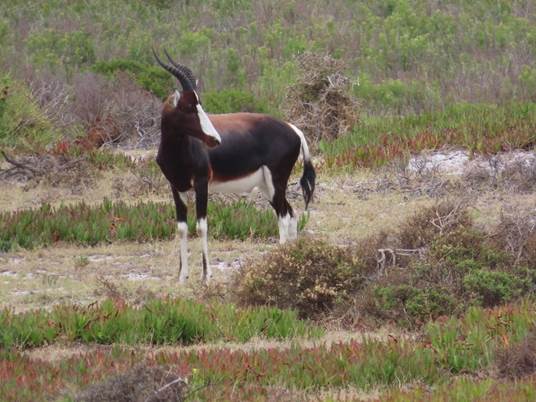
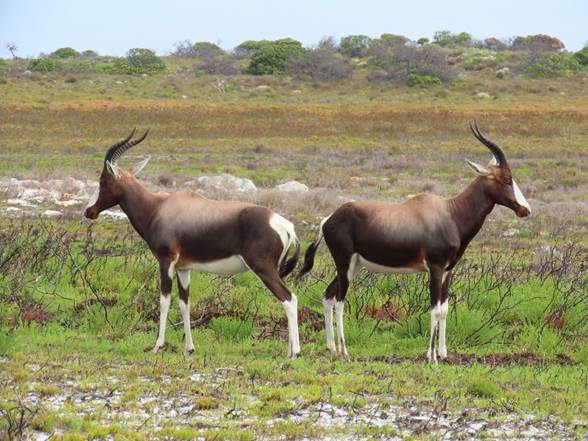
  • Bontebok

It’s all in the Afrikaans word bont, meaning colour.  Man has not been kind to these beautiful animals – by the early 1800s, there were 17 left after they had been hunted to virtual extinction for their meat and skins.  These 17 were fenced in by a farmer and unlike other antelope species, they couldn’t jump out.  So today, while they are still protected in the wild – there’s even a Bontebok National Park at Swellendam set up for their protection – we can enjoy seeing them (3,500 of them according to San Diego Zoo which takes part in their continuing conservation programme).

  • Rote Hartebeest

These are weird looking, aren’t they?  But Dominic was very excited at seeing these as well because he has seen them only rarely in the Cape of Good Hope Nature Reserve, even though through Southern Africa they are not in danger.  Our stock as clients was increasing by the minute given the range of beasties we were seeing with him.

  • Cape Crocodile (Black Girdled Lizard)

Dominic gave us lunch in the shade of the Nature Reserve tourist office.  On the way back to the car, we saw this lizard coming out of a wall, looking amazingly like a baby croc.  While they are not found outside the Western Cape, they are locally abundant in rocky areas from sea level to the mountain tops.  Despite their restricted location, they are not endangered – even though they are very popular as pets (ugh!).

  • Green Milkweed Locust

Dominic found this bug. Having never seen a locust before, it seemed harmless enough but then I read the de Wets Safari website entry – the photo is theirs too:

“The Green Milkweed Locust, or African Bush Grasshopper, is a large – up to 9cm long – poisonous locust that can congregate in enormous numbers (as we experienced on Sunday at the Walter Sisulu National Botanical Garden, apparently an annual occurrence there in September and October), and may migrate over great distances, flying strong and high. They feed on toxic plants and are rather sluggish on the ground, preferring to stay in trees and bushes and flying between them. When feeling threatened they will raise and rustle their wings and exude a noxious foam (poisonous if ingested) from their bodies as defense. Eggs are laid in the ground and the nymphs (also called “hoppers”) are highly gregarious, moving around in tight clusters until they are almost fully grown.

And yes, they scare me. Terribly.”

What a Surprise!

What surprised me about our trip in January to Cape Town?  Well, pretty well everything.

I shouldn’t have been surprised by the first thing, given that I now have a new roof on the house in Jersey and I was delayed leaving the island (once again) before Christmas last year.  Storm Eowyn arrived in the UK the same day we were due to leave (Friday 24th January 2025) bringing with it winds of up to 100mph near Glasgow Airport.  Emirates told us on the Thursday we wouldn’t be leaving the next day, but had rescheduled us to go on the Saturday, so we lost a day and that meant we wouldn’t be able to pick up the car rental either because the firm, RentaCheapie, wasn’t open on Sundays (it’s all in the name).

I’d only flown Emirates once before, in 2008 to Mauritius and on the way back, I’d had wanted a stopover in Dubai to visit a former Deutsche Bank colleague.  I seem to remember they were good but didn’t have a clear memory of anything in particular.  However, they fly the A380 daily from Glasgow and I hadn’t flown in that plane before, they were cheaper in Business than BA, and the idea of not having a 12 hour flight was appealing, albeit involving a longer total journey but broken into two parts. 

I didn’t think I could be surprised in a good way by an airline ever again but their service was superb (the A380 was luxury personified, and we even arranged for a driver to meet us in Cape Town at short notice and take us to where we were staying, given that we had no hire car).  I now never want to fly long haul with any other airline ever again –  certainly not BA who, according to a recent poll. have won the long haul race to the bottom.

Look at the number of Emirates A380 cabin crew! They had been walking round with bottles of Veuve Clicquot before serving lunch 😊

Another nice surprise was the welcoming, caring hosts everywhere we stayed.  We picked most of our stayovers at random, apart from staying with our friends Gus in Cape Town and Garth in Swellendam who had recommended his friend Uwe in Barrydale.  Everyone was so kind and the personal touches made that aspect of the trip really special.  One example of this was that our first hosts in Constantia insisted on driving us to Sabine’s 9.15am lecture for the first two days until we finally collected the hire car on the Tuesday.  The fact that four of our hosts were of German origin made Sabine feel even more at home.

Following on from that, the next surprise was to ask how could Cape Town be so congested?  Tom Tom reckons in terms of travel times, it’s #3 worst in Africa, #106 in the world.  We can attest to that – we hit gridlock literally after dropping the car off because there was a rugby match on at the main stadium.  Poor Gus was driving. However, most of the cars were new or newish, there were a lot of 4x4s and a lot of Chinese-made vehicles most of which I’d not seen in Europe.  Generally you got a feeling of relative affluence in a country and continent where any kind of affluence is in short supply. 

The other side of the coin of course is that there is virtually no public transport (buses and trains) with the general population relying entirely on minivan taxis to get to and from work, the owners of which, so we were told, having shown in a recent strike of taxi drivers that they have the region’s economic activity by the throat.  So our host driving us to the University was a true gesture of goodwill as we sat in a five mile jam the first day – he found a much better route the next day which we used for the rest of the week.

And to underline the point about no trains, I can happily say that we saw three trains the whole time we were there, two in Cape Town and one outside a place called Ashton.  One of the Cape Town trains was a freight train at the docks when we dropped off the RentaCheapie hire car.  The other was an almost empty commuter train (but it was a Saturday). 

The strangest one of all was the Ashton train, a steam locomotive in a siding uncoupled from a full set of older style carriages.  We’d followed a narrow gauge track seemingly all the way from Barrydale on our way to Stellenbosch when I saw it.  It was so incongruous, given that we’d seen NO other trains, old or new.  It seemed to belong to a completely different world (which of course it did).  I had to research it when I got back and this is what I found it – https://www.robertsonr62.com/new-cape-central-railway – a fun thing to do on a Saturday next time we visit.  The surprises just keep coming.

On board 😊

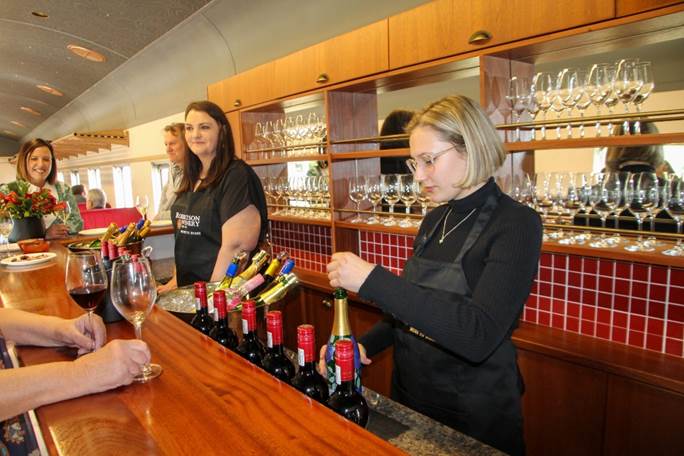
We did do two wine tastings (De Krans in Calitzdorp and Marianne Winery in Stellenbosch) and sadly didn’t have time for a third (Idiom near Sir Lowry’s Pass which I think would have been the best).  The surprise with the two we did was that I didn’t really like any of their wines – none.  However, our Constantia hosts put a wonderful bottle of Chenin Blanc in our fridge for our arrival (but we can’t remember the name).  We had other lovely wine in restaurants, one of which was the wonderful red from the Constantia Uitsig winery that I’d really been impressed with on both previous visits to South Africa (2007 and 2009).  It was, however, definitely worth going for the more expensive wines on the wine list (which in any case mostly weren’t very).  And the food was fabulous and also not expensive.  I’ll see if I can do a separate post on our culinary memories.

One of the most important aspects of the trip was the lectures that Sabine gave at the Cape Town University Summer School and I was not expecting the following that she had there.  People signed up for her course (The Frozen North – Inuit Art and Culture, 75 minutes each day for 5 days) simply because they had so enjoyed her previous pre-CoViD lectures.  She had a steady 30+ attendees and they were truly rapt in attention when I looked back at them.  CTU has asked Sabine back next year.  The comments to her afterwards showed how much they appreciated the course.  We were entertained on separate occasions by four of her “students”, who clearly wanted to show their gratitude, and their hospitality together with their really interesting life stories were a surprise to both of us. 

On that note, when I think back to the people we met, it was a surprise that, socially, we came across no-one black or coloured (a specifically South Africa distinction?).  Yes, a coloured cop stopped us at a police checkpoint, and certainly we were served by blacks and coloureds in restaurants and at our various B&Bs.  We noticed that a lot of the blacks in the restaurants were from Zimbabwe.  But everyone we met socially was from the white, educated, older and retired, and relatively privileged section of Cape society.  The life they live, albeit surrounded at home by varying levels of security, is a very good one by any standard and it was important to remember that not everyone lives like that there and I’d say that society is still quite divided.

Another surprise was that driving the 1000km on the Garden Route was so easy and trouble free, and at no time did we feel unsafe.  It was all quite normal, contrary to what I had feared (but with no point of reference).  Certainly we saw townships, both large and small, some seemingly ok but most awful looking, and while we struggled to understand how anyone could live in that kind of habitation, the people we saw didn’t seem bothered.  It may be the old story of what you’re used to, I guess.

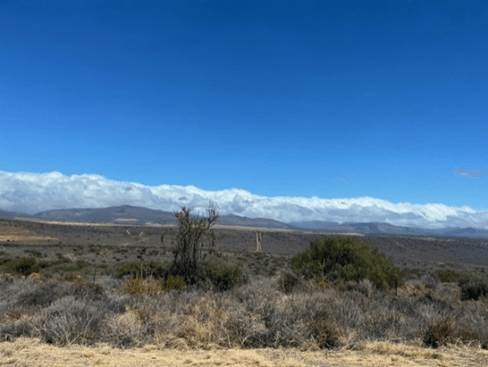
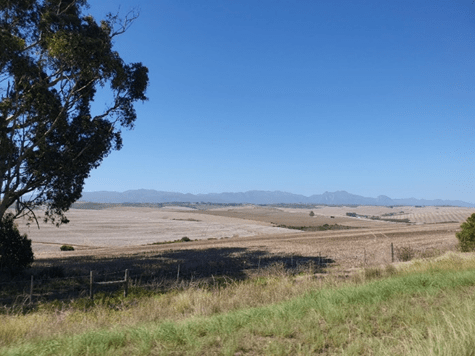
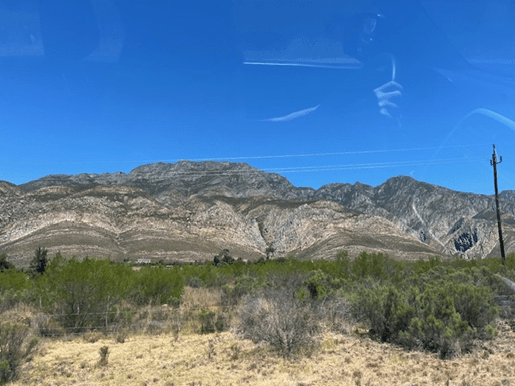
The driving took us through some stunning countryside, some with gently rolling hills and long views to the horizon; another landscape was larger rocky hills with the road following the valley floor alongside a river (and often an unused railway line).  Quite a lot of the land had no evident sign of habitation or cultivation while some of the landscape reminded me of parts of the US I’d seen out west.  At times, you felt you were really in the back of beyond, but still on good quality and not particularly busy roads.  All this was a surprise, but what made it even better was the courtesy of the other drivers, who if slower than us almost without exception would pull onto the hard shoulder to let you pass more safely.

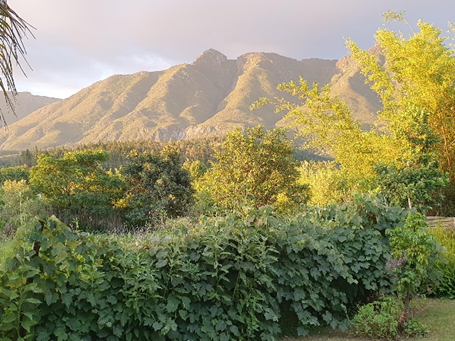
As you can see from the photos, the weather was not a surprise, thank goodness – in fact, it lived up to our every expectation.  We had one day in Cape Town when it rained, but after the lecture we went on a wildlife tour that took us south over some hills towards the Cape of Good Hope, into dry and brighter skies.  The rest of the time the sun shone, it wasn’t too hot (high twenties most of the time), it wasn’t humid and there was no wind. A complete contrast to what we’d left behind and would not look forward to on our return.

Talking of wildlife, another surprise was the variety of wildlife, not just birds, in the Cape Province.  We didn’t mean to make the trip all about nature but managed to go on five wildlife tours of different kinds.  Two were all-day in and around Cape Town after Sabine’s lectures with Dominic, The Fynbos Guy, taking in Kirstenbosch Gardens, the city’s sewage works (a particular favourite for birds and birders alike), and the Cape of Good Hope Nature Reserve.  We had a safari-light tour of the Idiom game reserve with the ranger, Andrew, (which is why we didn’t then have time for the wine tasting – you could say we had our priorities wrong) and in Wilderness we did an early morning boat tour of the lake.  The last one was a simple walk over farmland outside Oudtshoorn with Lynette of A 2 Zebra Adventures (she also does tours of the Great Karoo region just north of where we were which would be on our list for next time).  I’ll do a separate post on the wildlife we saw.

Andrew at Idiom, overlooking False Bay

And then there was the potter in Swellendam.  His name is David Schlapobersky.  We went to see the birds at the feeder in his beautiful garden with Garth and a couple of keen birding friends who helpfully knew what we were looking at.  We went back to the pottery on our way out to Wilderness the next day and bought some of his wares.  He was a little eccentric but Sabine in particular was very impressed by his work – a very talented artisan and, as we learnt, with a heart of gold.  I’d love to have the urn as a feature in the garden in Scotland but, with our frost, maybe not a good idea.

https://pottery.co.za/

Our particular thanks go to Gus for letting us stay with him and for looking after us for two weekends.  It was also great to see his daughter and son-in-law again and meet his young granddaughters.  All in all, an amazing 2+weeks which really was just a taster and we can’t wait to go back.