I’ve had to split this story in two – too much to say in one post. This trip wasn’t meant to include a safari of any kind, but we did manage to arrange some birding day or part-day tours that brought us close to non-bird wildlife. Here’s what we saw. What struck me was the variety and also how much depended on luck – seeing most of the animals was random, the luck of the draw, completely unplanned (just like birds). I’d never heard of a lot of them, so I’m guessing neither have most of you. Each in their own way were quite special.
About half of them we saw with Dominic, the Fynbos (pronounced Fainboss) Guy on the two one-day tours in Cape Town and in the Cape Point Nature Reserve. Despite being British, he was very knowledgeable – he came out when he was 19, and started off guiding for safari lodges in Botswana before moving south and setting up his own business. Each day was different and fantastic. The other main exposure we had to non-bird wildlife was with Andrew, the ranger at the Idiom Winery Nature Reserve, who took us for an hour’s game drive.
- Baboon
Baboons were everywhere and have become an urban pest.
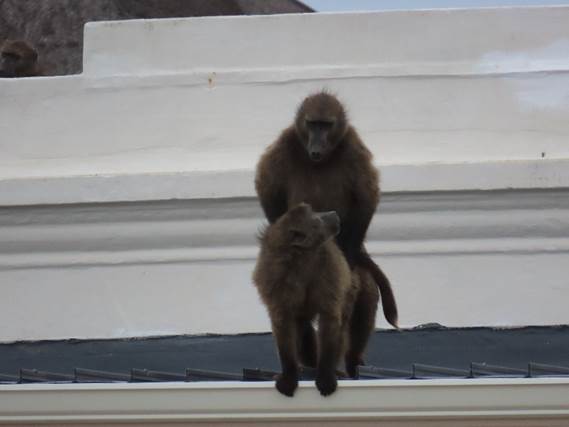
This might be why there are so many of them 😊
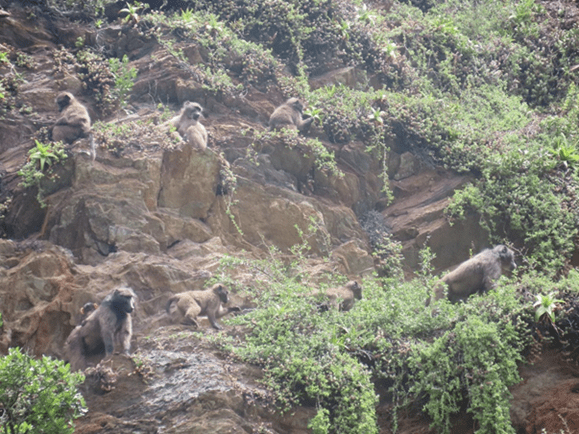
And this is more like where they belong
- Angulate Tortoise
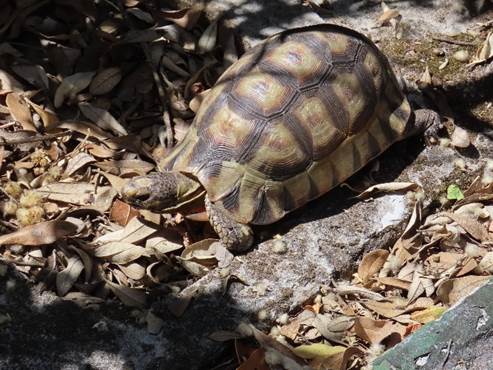
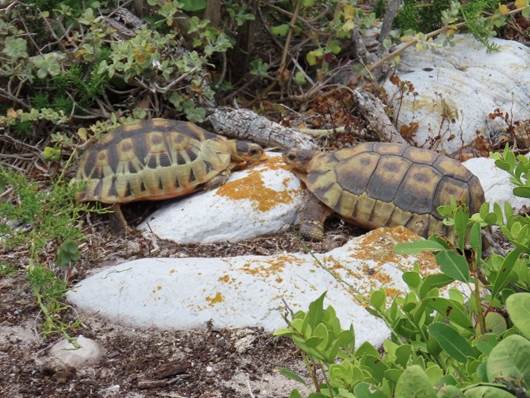
We came across them in two locations and their conservation category is Least Concern. Contrary to a tortoise’s reputation, they can move quite quickly when they want to and they are easily camouflaged in the undergrowth. They’re very territorial and in the bottom photo, two males are facing off – the one on the right came out on top.
- Cape Dune Mole-rat
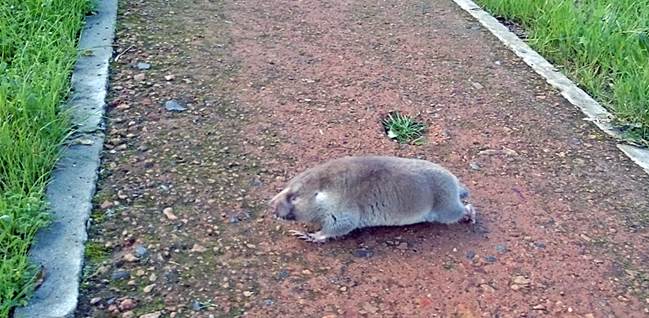
We’d only just been talking about moles and mole-rats when Dominic spotted a mole-rat by the side of the track at the sewage works. It scampered away from us as we went to get a closer look, so this is a picture taken by someone’s camera trap. Dominic was very excited because you don’t usually see them in daylight as they live most of their lives in burrows in sandy soil. He said it was either ill or looking for a mate and it didn’t look ill. They’re fat and ugly with projecting pairs of top and bottom teeth – being mostly blind, presumably looks aren’t important to other dune mole-rats.
- Dassie
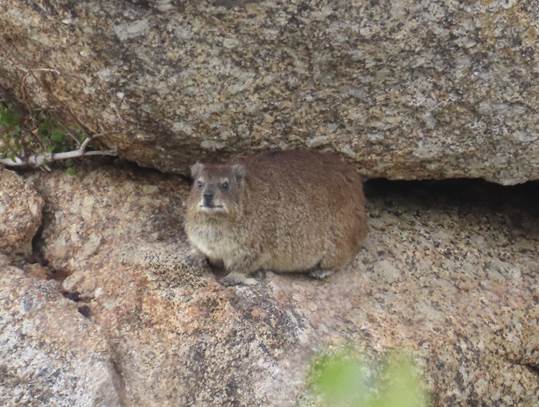
We saw several dassies on Boulders Beach, Simonstown in the same area as the penguins. Go Wild provides this description of them – fortunately or sadly, we didn’t see any heart-stopping capers:
They’re small, cute and rather special – rock hyraxes, also known as dassies. Visitors of the South African coastline marvel at their heart-stopping capers among the rocks, cheerfully ignoring the plunging chasms below.
They may look like groundhogs, but their closest taxonomic relatives are actually the elephant and the manatee. (My note – what????)
And that’s not the only odd thing about them. Dassies are distinctly sociable – in their mostly harmonious family life, of course, but also in squabbles among themselves. Unusually for herbivores, their foraging needs only take up an hour or so of every day, leaving these sun-loving creatures plenty of time left for playing, snuggling or just lounging around.
They have some pretty unusual anatomic features too: the irises of their eyes can contract to such an extent that they can look directly at the sun, and the soles of their feet are retractable, which makes them extremely well-suited to climbing around their rocky habitat. And last but not least, the male dassie can sing – at least when he’s courting the lady dassie of his dreams. All in all, they are a peaceful bunch but when cornered, they can be fierce adversaries.
- Bontebok
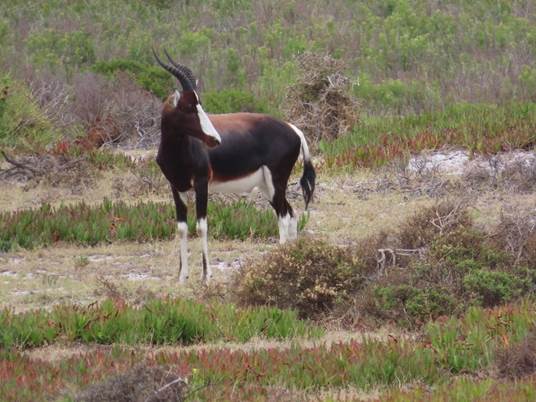
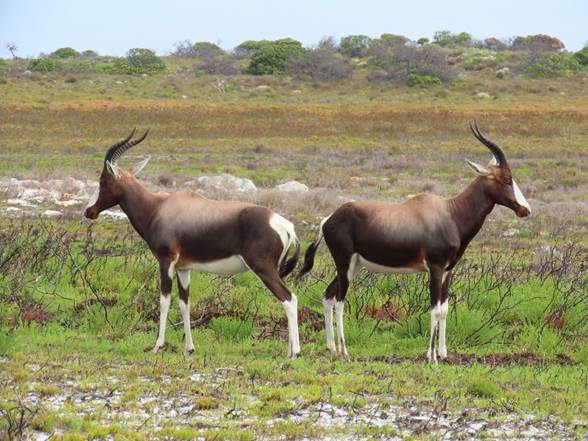
It’s all in the Afrikaans word bont, meaning colour. Man has not been kind to these beautiful animals – by the early 1800s, there were 17 left after they had been hunted to virtual extinction for their meat and skins. These 17 were fenced in by a farmer and unlike other antelope species, they couldn’t jump out. So today, while they are still protected in the wild – there’s even a Bontebok National Park at Swellendam set up for their protection – we can enjoy seeing them (3,500 of them according to San Diego Zoo which takes part in their continuing conservation programme).
- Rote Hartebeest

These are weird looking, aren’t they? But Dominic was very excited at seeing these as well because he has seen them only rarely in the Cape of Good Hope Nature Reserve, even though through Southern Africa they are not in danger. Our stock as clients was increasing by the minute given the range of beasties we were seeing with him.
- Cape Crocodile (Black Girdled Lizard)
Dominic gave us lunch in the shade of the Nature Reserve tourist office. On the way back to the car, we saw this lizard coming out of a wall, looking amazingly like a baby croc. While they are not found outside the Western Cape, they are locally abundant in rocky areas from sea level to the mountain tops. Despite their restricted location, they are not endangered – even though they are very popular as pets (ugh!).

- Green Milkweed Locust
Dominic found this bug. Having never seen a locust before, it seemed harmless enough but then I read the de Wets Safari website entry – the photo is theirs too:

“The Green Milkweed Locust, or African Bush Grasshopper, is a large – up to 9cm long – poisonous locust that can congregate in enormous numbers (as we experienced on Sunday at the Walter Sisulu National Botanical Garden, apparently an annual occurrence there in September and October), and may migrate over great distances, flying strong and high. They feed on toxic plants and are rather sluggish on the ground, preferring to stay in trees and bushes and flying between them. When feeling threatened they will raise and rustle their wings and exude a noxious foam (poisonous if ingested) from their bodies as defense. Eggs are laid in the ground and the nymphs (also called “hoppers”) are highly gregarious, moving around in tight clusters until they are almost fully grown.
And yes, they scare me. Terribly.”
 Pete's Perusings