After the leopard climbed the tree, we thought that would be that. Just the long journey back to the camp, along stoney, untarmacked roads made from soil and rock dug out of ground level quarries at intervals by the roadside. We were right about the roads but wrong about not seeing anything interesting.
First we had this magnificent view of a large heard of African buffalo in the distance.

Then we can across three female lions lying by the side of the road, dozing and looking very peaceful.

Shortly afterwards, the guide in another jeep told us that they were part of a large pride that, earlier in the day, had attacked a herd of Masai cows, killing six animals. No wonder they looked so contented.

And, as if we needed confirmation of the massacre, the next animal we saw was a hyena carrying a limb of some sort in its mouth, followed by another lion with its head inside the carcass of a cow.
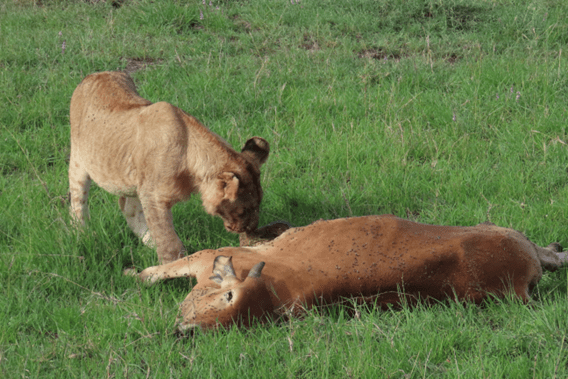
We came across one male drinking from a pool, collapsing sideways as we stopped (Sabine’s photo caught him just as he began to topple over) and falling fast asleep, clearly having eaten his fill at the table. Life was good if you were a lion, not so much if you were a cow.

The whole area was, in fact, littered with lions feasting on carcasses. We counted what we saw and seemed to come up with more than six. The herd of cows with the Masai minders were long gone.
And at a safe distance from the lions came the hangers-on – spotted hyenas, several kinds of vultures, a marabou stork and side-striped jackals, attracted by the smell. They were all waiting patiently for the lions to finish so they could have their turn.
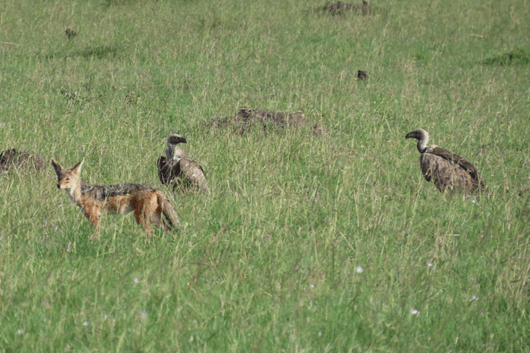
It was a bit gruesome, seeing all this carnage, but that wasn’t the real problem. Simon was actually quite concerned. He kept shaking his head and muttering “Not good”. And of course this was because it went against the natural order of things.
The cows shouldn’t have been there, the Masai have far too many domesticated animals for their land (signs of wealth and status) and as a result choose to ignore (unfenced) boundaries, and the cows are easy prey for predators. The lions therefore could get used to having prime rib on the menu, which would not be good at all. We heard the next day that another pride had come in from another area and done the same thing.
The Masai are encouraged not to revert to the old ways and hunt the lions doing the damage. Instead, they are rewarded for their restraint by being paid compensation for animals. Sabine and I both recall Simon saying, in his area at least, it was on a 2 to 1 basis, and while I haven’t been able to confirm that ratio, if true the cynic in me might be tempted to think that putting your herd in harm’s way every now and then might be a smart business strategy.
There has been much research into the effectiveness of such compensation schemes, and the general conclusion seems to be that they do stop the lion and other predator populations from shrinking. At the same time it is another example of how the Masai way of life is being threatened by the need to serve the western world’s values of conservation and tourism.
Honestly, it was a relief to leave the killing fields behind as we headed for the camp, still quite a long way off. The terrain was a mixture of recently-laid roads, roads that needed a lot of repair work, and tracks across the grassland.
We saw several more of the species we’d seen earlier in the day, mainly antelopes and elephants, plus a few warthog families snuffling about in the grass. We’d even had a warthog family come through the camp day we arrived. While the males are usually solitary, a group of sows and piglets is called a sounder. And they all did it wherever we saw them – their default snuffling position was on their knees.

We drove past a jeep stopped off the road and Simon pulled up. The jeep had a ranger in it and he was standing watch over a cheetah about fifty metres from him. Cheetahs struggle to keep their kills against stronger predators, including lions and hyenas. Not only are they endangered, but this one had a cub. We didn’t get photo opportunity because they were both sheltered by a bush, but the concern and dedication of the reserve’s rangers were impressive. We saw three cheetahs over the four days, two that day and here’s the one we saw the day before. Truly magnificent.

As we headed up one rise, there were some very small antelopes by the road that quickly moved behind the shrubbery as we came nearer, hence no photo. “Tick tick”, said Simon with a chuckle, or at least that’s what it sounded like. “Smallest antelope. You’ve seen biggest and smallest today.” The biggest was the eland, if you remember from Part 3b.

Kirk’s Dik-dik (Wikipedia photo)
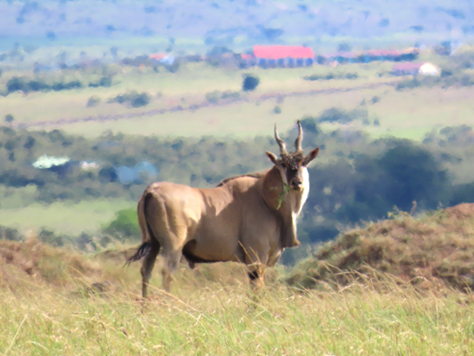
Common Eland
Not wishing to be picky (but just in case someone reading this is a perfectionist), the Common Eland is not quite as big on average as the Giant Eland found further west in Africa, so it isn’t actually the largest antelope, just the second largest. But Simon was correct in terms of the Masai Mara Reserve.
Oh yes, in her post on collective nouns for African animals, Ashley Kemp, a naturalist, had to make one up for elands because she couldn’t find one – a disproportion. I’m not sure about that one. I think “a muscle” would be good given their impressive physique, but happy to take suggestions.
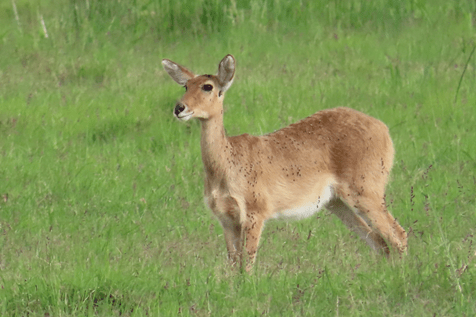
Back to the road trip, the drive from the Dik-dik to the camp lasted an hour or more. We could begin to recognised the landscape as we got closer, particularly the airstrip where we had landed a few days before. It reminded us that the first animal we saw after being collected by Simon two days before was a reedbuck. This is a female; the males has horns. Note the flies – on every animal, it seemed.
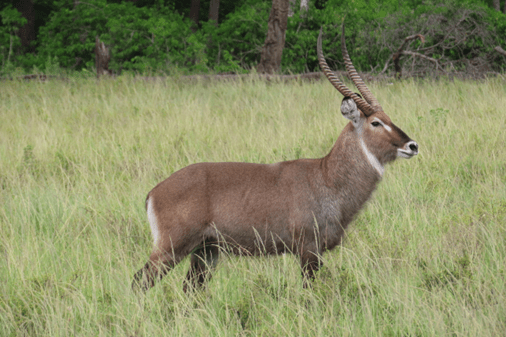
What we also hadn’t seen that day, but had seen on the other two days, was a waterbuck. The Kenya species has slightly different colouration from the ones I’d seen in Kruger in that the latter had a definite ring of white fur around their backside, making them look like a target from behind. The ones we saw In Kenya just had white fur all over their rear end. Beautiful animals, even without a special collective noun. “Herd” is always there if you need one.
On the final stretch of the journey home, we saw a monitor lizard fast pedalling it into one of the pools that had done us proud with bird life the day before. No collective noun, probably because they don’t go around in groups.

And very close to the camp, we drove past a baboon family heading for the trees they called home. It was one of three primates we saw during our stay, the other two being around the camp – Vervet Monkey and Syke’s Monkey.

Vervet Monkey

Syke’s Monkey
Being primates, baboons have been widely researched, as you can imagine. Someone posted a photo of a family of baboons with the caption saying that they were collectively called a congress, which then produced various levels of indignation. The correct term is troop. However, Shirley Strum, a research naturalist at the University of California noted “I would prefer to be governed by baboons than the current Congress! They are more socially committed, abide by the golden rule (treat others as you would wish to be treated) and are generally nicer (than those) people.”

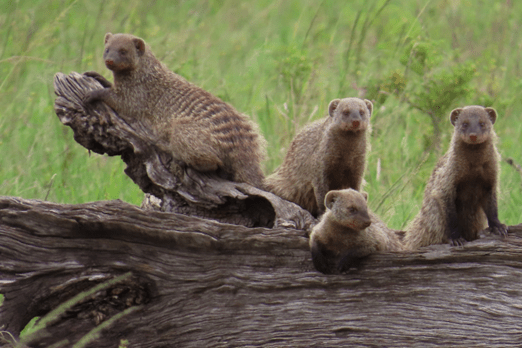
Our last animal of the tour was a family of banded mongooses (please note the correct plural). We got a good look at them on our first day on the drive from the airstrip and they were in the same place, using a fallen tree as a base and lookout point. Collectively, there are several nouns including my favourite, a committee.
And finally, at dinner that evening, we were joined by our last animal of the day, a yellow-winged bat. It flew into the dining tent, scooped up bugs that, attracted by the lighting, had accumulated on the ceiling and flew out again. This happened several times over the course of our dinner.

It looked much darker to us in the evening than in this illuminated bat photo (which does show its yellow wings nicely), and it was quick too, but our camp hosts were certain that was the correct identification. We only saw one at a time, but there are several words to describe a group – a cauldron or a colony when at rest, a cloud, a swarm or a flight in the air.
If anyone has been counting the species mentioned in the three sections of Kenya – Part 3, it should come to 28. Two other animals are also on the list; we saw one the day before the Big Five Day and one on our last morning drive. In some ways, they are at opposite ends of the animal spectrum. I hadn’t seen either of them on the previous Kruger safaris.
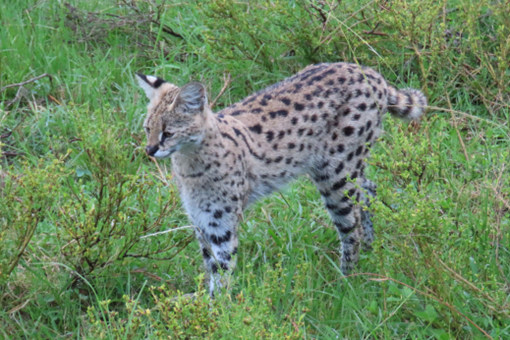
The first one was a very pretty serval cat, almost the first animal we saw on that morning’s drive. It was delicately built, with lithe movements and very alert. We watched it try to catch something by leaping into the air and dropping down on it, but in that instance it was the prey’s lucky day, not the cat’s. I don’t think there’s a specific word for a group of serval cats, but one of the many words for cats in general is a pounce, which I think is quite applicable here given what we saw it do.
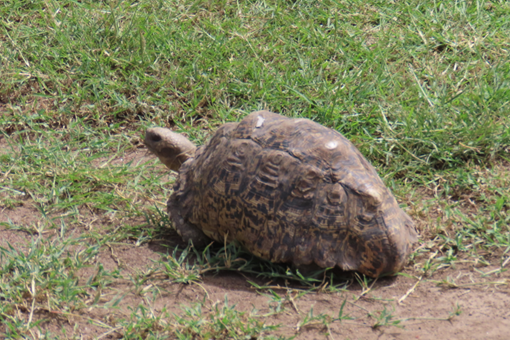
The thirtieth animal on our list was a leopard tortoise and, while not huge by any means, they are the fourth largest tortoise in the world. Grazers and widespread across the arid and savannah terrain of eastern and southern Africa, they can have a lifespan of 80 to 100 years. I think this one is older, given its faded markings. Needless to say it didn’t move very fast (collective noun – a creep). It eventually disappeared, ambling into some longer grass at the edge of a wood.
And that brings me to the end of the animal narrative. We had an amazing experience watching them all, and we were left with a feeling of deep respect for their endurance in a world so completely at odds with the relatively pampered life led by most animals, wild and domesticated, at home.
Next: Kenya – Part 4 is all about the birds!
 Pete's Perusings
Very good Peter. Glad you saw and got lots of nice photos. Learning the names of groups of animals is obviously interesting and surprising, however sadly for some they’ll be lucky to be in a group the way things are going.
Look forward to the birds, and suspect probably less info as it will be quite long?
LikeLike