This is all about the animals. In the interests of giving you manageable sections to read, Part 3 comes in 3 parts, with lots of photos from Simon/Sabine and me.
Let’s start with The Big Five, a term you hear all the time on a safari holiday. It was coined by big-game hunters, referring to the animals they found the most difficult to hunt on foot. I struggle to feel sorry for them as they clearly have no shame. The five are:
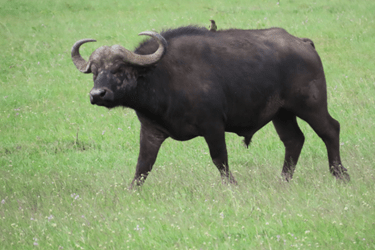
African Buffalo
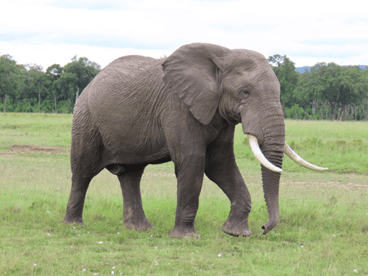
Elephant

Leopard
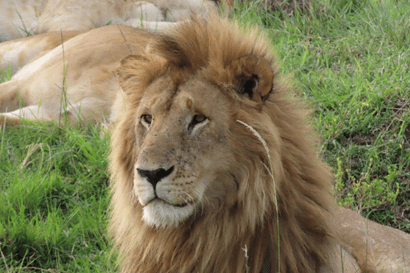
Lion

Rhinoceros
(taken on a previous safari – the one we saw was too far away for a photo)
It becomes a point of principle that a good safari requires you to have seen all five. People come away feeling incomplete and disappointed if they don’t – “ We only saw four, not the leopard” volunteered a couple we met at our beach hotel. It seemed they needed to get that off their chest at the outset. They sounded a little despondent, cheated even and definitely apologetic, as if they were afraid we might think less of them. Which we did, of course. We told them that we’d seen all five and on the same day, and I’m pleased with the way we built in just the right amount of smugness.
That was on our Day 2 when Simon took us on that amazing 50 km tour of the Masai Mara, into areas where he knew a rhino and a leopard had been seen very recently. In all, our list of animals came to 30 species of all kinds and while we saw a lot of them several times, we saw the most on that one day. I’m therefore going to base most this story around that day.
It started with breakfast at 6am. What a palaver. The particularly early start was necessary because Simon wanted to start the drive at 7am. However, he had to drive from our camp to the one on the other side of the river just a kilometre of so up-river, a journey of an hour – 30km on the reserve’s untarmacked rough roads. Because there was no bridge close by. He left when we were getting up so as to be there on time.
We on the other hand had a nice breakfast, watched the party of three balloons take off across the river from the camp we were heading for, jumped in a different jeep for the short ride to the tiny ferry that would take us the 10 metres across the river. We were met by one of the other camp’s guards and escorted to where Simon was parked. Easy for us, certainly.
We set off and immediately noticed a different feel to that side of the reserve. I’ve mentioned it was under different management and it showed. Better roads and fewer safari jeeps. We stopped a few times to look at elephants and birds and then Simon saw the rhino in the distance. Sabine and I hadn’t seen the rhino at all as it was in long grass and a very long way off. Simon raced off down the road, narrowly missing an elephant calf that was the laggard of the herd crossing the road in front of us. He took a track off the road on the right to position us in a spot that would bisect the route he could see the rhino was taking.
After a lot of coaching, he got us to look in the right place and we could just see the rhino. He said there was a calf there too but we never saw it in the long grass. The mother was making slow progress towards us, stopping quite often, presumably to graze or wait for her calf. We could see other safari jeeps beyond her looking at a lion and at elephants, and it quite obvious they hadn’t clocked the rhino at all.
Then, while we waited patiently for her to get closer and when our attention was elsewhere, she just disappeared, vanished, hence no photo. Simon said she’d lain down in the grass and he didn’t think she’d be getting up any time soon, a particularly selfish act on behalf of the rhino. But at least we saw her.
So we set off again at a more leisurely pace. We were passed by a tractor and trailer coming the other way carrying one of the ballons (now deflated) and its basket that we’d seen take off earlier. We later saw the other two being dismantled and the catering party clearing up after the passengers had been given breakfast. Very civilised, and rather colonial it seemed to me.
We passed about 10 giraffes grazing peacefully on our right. Do you know the collective noun for giraffes? There are several – one is a kaleidoscope, another is a journey of giraffes (my favourite) or a tower, fitting for the world’s tallest animal – fully grown they are four to six metres tall and their necks can be up to 3 metres long.

About a kilometre further on we were looking at a herd (or a parade, which I like more) of elephants also on our right when Simon stopped the jeep. Lying on our left next to the road on a slight bank was a male lion. Who took no notice of us at all.

Here are some of the elephants and across the road ……
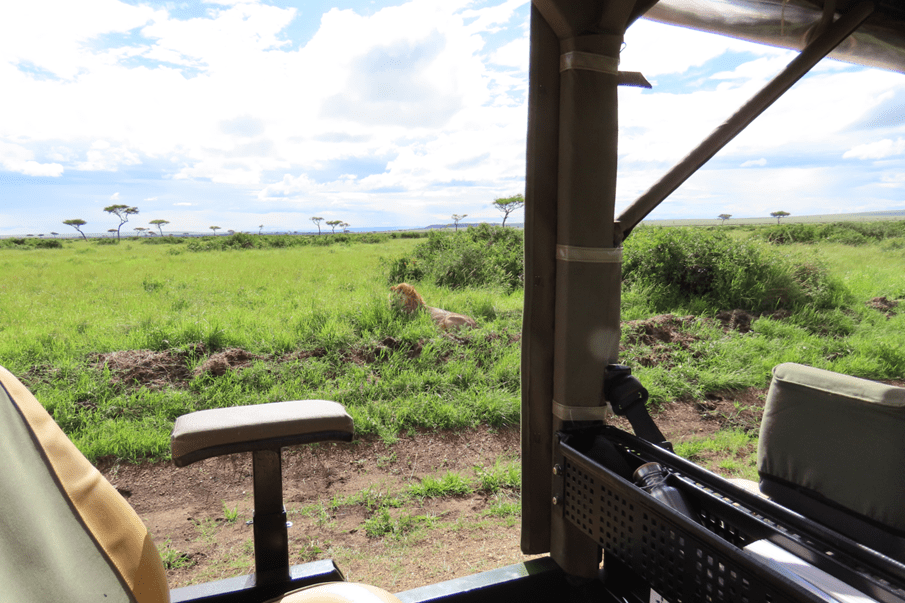
He’d been in a fight – you can see the wound, covered in flies, above his eye. Flies were all over him, in fact.
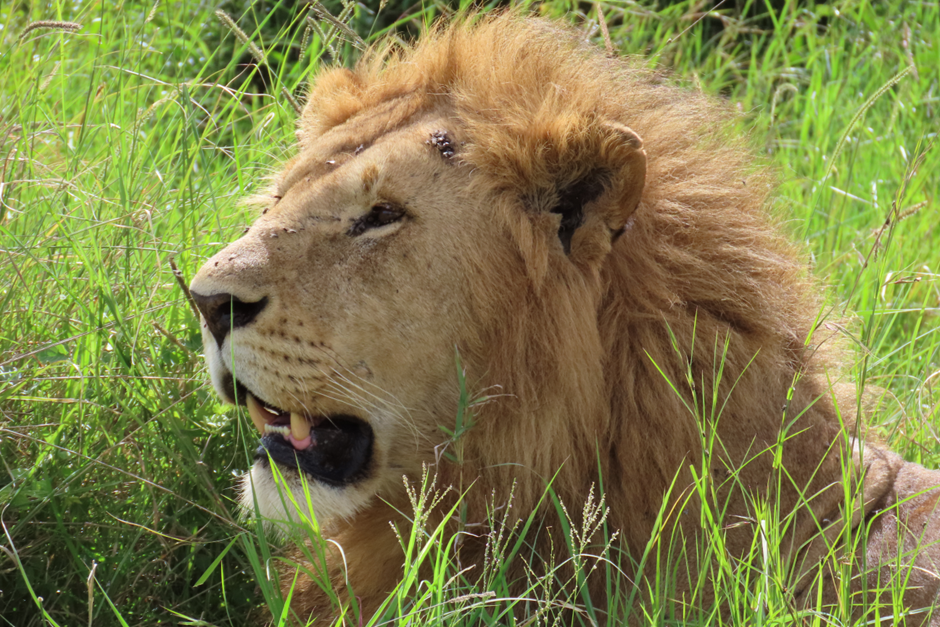
And then he got up, crossed the road and lay down again in the shade – sensible as it was already getting hot at 8.30am.

Collective noun for lions? You know this one – a pride, made up mostly of females and cubs, and one male. But what do you call a group of just male lions? A coalition. Very apt. They need to band together in small groups because they are not strong enough to be a dominant male and therefore need protection against other males.
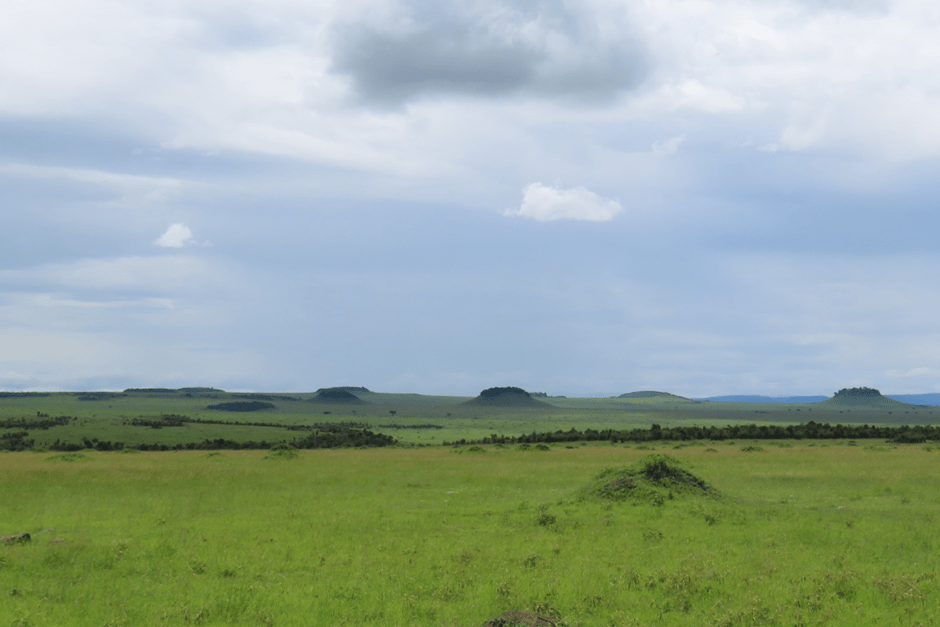
We then drove quite a way, seeing the odd loan elephant in the distance and stopping to look at birds (the next story) but we had to wait for about an hour or so before seeing more animals. The scenery was vast, flat and open, a complete contrast from the reserves in Kruger which were more hemmed in by the shrubland vegetation and where you had to go looking for the animals, coming across them rather than seeing them all around. I prefer Kenya.
Part 3b to follow shortly ……………
 Pete's Perusings
Good stuff …. The problem is those who’ve been on safaris & those who haven’t are 2 very different audiences !….
In South Africa there is a great debate about the extent to which the wilderness is really a super Disneyland ….
In the Galapagos they have the big 15 …but you have to do a lot of different islands to see them all ! think I saw 11 ( on 5 island visits )…but the highlights aren’t getting another one so much as something else, eg the strange setting u catch them in ..
Bob b
LikeLike