So now I‘ve made you suffer through my angst about BA, I can tell you about the other parts you really want to hear about.
After we landed in Nairobi, we stayed overnight at an airport hotel and the next morning flew in a small plane from a regional airport to Musiara Airstrip in the Masai Mara that served the two Governor’s camps on that side of the Mara River. We were staying at the one called Il Moran. Governor’s Main Camp was the other. We were met by Simon who’d be our guide for the duration of our stay.
So let’s start with Simon. From further north in Kenya, 59 years old but doesn’t look anything like his age, has worked for the Governor’s organisation for 40 years, due to retire next year but wants to carry on freelance with his own vehicle. With the most delightful personality and amazing knowledge of the flora and fauna, Simon made the safari experience for us.
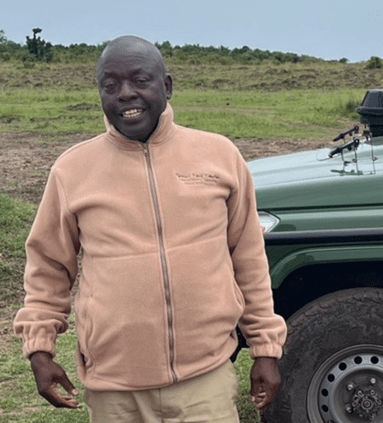
He showed us not just the animals but their behaviour too, a lot of which he was able to anticipate. That was especially true of elephants, the leopard, an ostrich, the rhino, baboons, and some of the birds, but overall it was a constant stream of information on just about everything.
What was a bit of a challenge for us was his English pronunciation, given that his own tribe would have its own language, then Swahili and English third. Of particular note were the names of birds. For example, he’d tell you that the bird was a Tropical Paw-paw, you’d look it up in the bird book and not find it, ask him to repeat it, still not find it, ask him to spell it, find it in the book, repeat to him what the book said it was (Tropical Bou-bou), and have him come right back saying yes that’s right, Tropical Paw-paw.
His phone went constantly, both calls and WhatsApp messages. A lot of this was to do with animal sightings. In the same vein, he’d stop or be stopped by other drivers as our vehicles passed and chat in Swahili for at least a couple of minutes. It was all very obviously sociable, with a lot of smiling and laughing. It was funny watching the clients in the back of the other vehicles who, like us, didn’t understand a word. Some looked very grumpy about the interruption. We simply took to asking Simon what had been said, because we felt we were missing out.
On one occasion he said he’d heard the other driver had died a few months ago, so was very surprised to see him at the wheel and had told him that. Another one he hadn’t seen for over 30 years – that exchange was made more involved because the other driver didn’t recognise Simon with his head shaved. He said to one of the park rangers that the ranger had been given a very nice new jeep in a way that suggested he didn’t think they should be spoilt like that. Another driver with a grumpy- and slightly entitled-looking couple in the back asked him to help find the same breakfast spot his clients had enjoyed when they’d stayed at Governor’s Main Camp a couple of years ago (and Simon guessed correctly where it was – not far – and directed them to it) – no show of gratitude from the couple, of course.
One of his many skills was his ability to take photos. He used Sabine’s phone and his own binoculars. He focused the binoculars on the animal, put the phone on camera mode, then using both hands he held the phone against one of the eye pieces of the binoculars, got the arrangement lined up by looking at the image displayed on the phone screen and took the photo. He was clearly a very capable photographer as the photos were stunning, He even made a video of elephants crossing the Mara River in this way.
We had Simon all to ourselves the entire time. That was from and to the airstrip, the afternoon drive that day, three full days and the morning drive of the day we left. No-one else with us. The freedom that gave us was fantastic but perhaps because it was low season, I noticed pretty well all the safari jeeps had only a couple or maybe a family. It meant we could have a constant dialogue with Simon about what we were seeing and where we were going, enjoy looking at birds if the mammals were quiet, go where we liked and choose what we would like Simon to try to find for us to see.
On one of the full days, he took us on a 50 kilometre tour of both sides of the Mara River, which bisects the immediate area around the camp. We’d already seen a lot of animals or so we thought, but Simon’s tour has left a huge impression on us of just how many grass-eating animals (he called them grazers) there are in the region and the variety.
He located two very scarce animals that day that we hadn’t seen, a rhino and a leopard, which meant that we saw all five of The Big Five in one day. We were the only people to see the rhino at that time – none of the other jeeps were close enough to have seen it and we lost it in the tall grass when it lay down.
Further into the day, he took us a few hundred metres across the border with Tanzania where the Masai Mara meets the Serengeti. The border is dead straight there and is marked by a line of trig point type concrete structures placed about 250 metres apart on the grassland going in both direction as far as the eye can see.
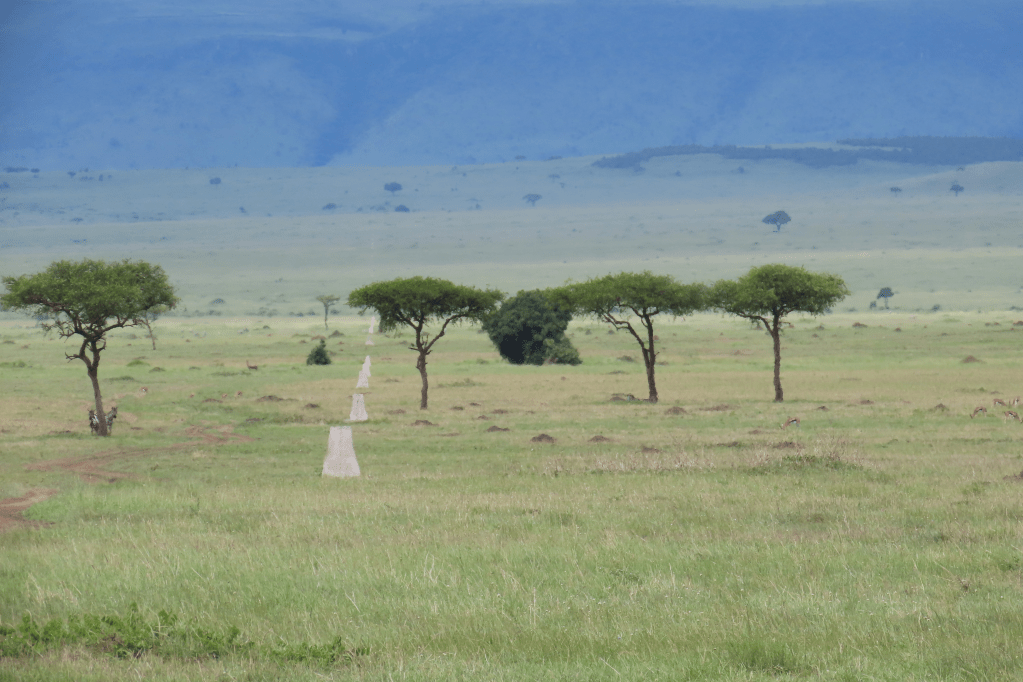
The track weaved between them. There were Keep Out signs telling you not to cross into Tanzania (but strangely not the other way into Kenya). The animals seemed to ignore all of that anyway. I was worried that we didn’t have a visa for Tanzania but Simon didn’t seem to be bothered – he just laughed and said he’d scoot back across the border if a ranger showed up.

All day we saw the differences in reserve management that were practised in the Masai Mara on the two sides of the Mara River (until next year when they’ll be combined into one, with the better lot taking control). On the far side to us, the roads were newer and better and the off-road penalties apparently harsher. Unlike Kruger which had a lot of private reserves, the safari jeeps were meant to stay on the roads or obvious tracks across the grassland, and the rangers did enforce it.
The better managed side had the benefit of being more remote from the tourist areas outside the reserve, so there were fewer non-safari camp vehicles anyway. On the side we were on there were a lot more independent safari business vehicles in evidence. Judging by what we saw of them, for example two jeeps hightailing it across the savannah to the road we were on, explaining to Simon that they’d been off-road and were running from the rangers, some of these enterprises were operated by cowboys.
And one of the big differences was the number of vehicles allowed to view an animal at any one time. On the better side, it’s five (from memory, Kruger was three or five) but on the other side of the river there was no limit. So when we saw the rarely seen leopard, the safari drums had been working overtime and there were at least 20 vehicles jockeying for position around this poor creature.
And that moves me nicely on to the vehicles. They were nearly all Toyota Landcruisers. I assume they were long wheel-based as they all had three rows of seats behind the driver. There were a few configurations in the actual seating arrangements but it seemed to come down to two kinds, as you can see from the photo taken as we arrived at the airstrip.
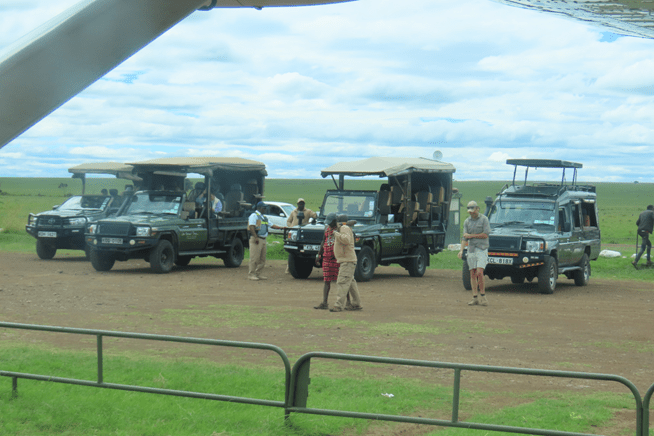
One kind is closed in like a people-carrier with three rows of seat behind the driver; some have sliding windows, some like the one on the right in the photo a better option with roll-up sides, but both have a pop-up roof that allows you to stand and see out. The other type (the three on the left) has completely open sides and a canvas roof, also with three rows of seats but stepped up front to back, and no pop-up top. Ours, second from the right, was the latter, thank goodness.
I say thank goodness because, without a doubt, the open sides gave us a certain sense of freedom, being part of the world we were observing, sometimes very close at hand. Because we had the vehicle to ourselves, we could choose to sit behind Simon to hear what he was saying or go further back to get a different view. I would absolutely not recommend the one with the closed sides and sliding windows despite the advantage of the pop-up roof. It seems too penned-in. Probably because they had to be driven on proper roads outside the reserve, most of the independent enterprises were of this closed-in kind.
Simon was a good, careful driver, but the Landcruiser’s capabilities were very impressive given the terrain. It could go anywhere and was very comfortable at the same time. He said he much preferred it to the later model Landrovers they used to have – the Landcruiser is more reliable and in difficult circumstances copes much better, for example if one wheel gets airborne when going through deep and very uneven ditches, something that happens from time to time in huge dips in the track after the effects of rain, other vehicles and elephants.
The sleeping accommodation was a large well-appointed two room tent, bedroom and bathroom, with a terrace outside overlooking the Mara River. There were only 12 tents, so it was only a short distance from the camp centre that had the dining room and bar, along with the kitchen, shop and manager’s office.

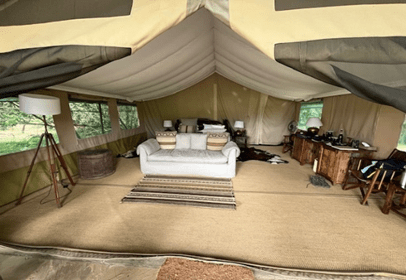
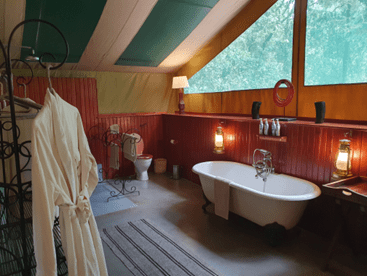

Morning and evening, we were escorted to and from the tent and the hospitality area by an armed guard, to protect us from any wild beasties that may have lingered overnight – we heard that the camp had been visited at night by hippos from the river below (a regular occurrence), an elephant and a giraffe while we were there. In the camp during the day, we saw a family of warthogs, Vervet and Sykes monkeys, a giraffe and a hyena.
The quality of the food and the service was first-rate. Three meals a day, and all drinks and laundry free of charge. We couldn’t think of anything they could have done better. Apart from changing the shower taps because they turned in opposite directions which was quite confusing. We had the camp to ourselves for two of the four days (one of the benefits of going in low season, the other being cost 😊), which made us feel very special indeed – our own private game reserve.
We had dinner back at the camp every night, but either breakfast or lunch could be taken on the game drive. If we had breakfast at the camp, it might be before the drive started at 6.30am or 7am. On one day, early, we saw three hot air balloons lift off from Little Governors Camp on the opposite side of the river and a little upriver.
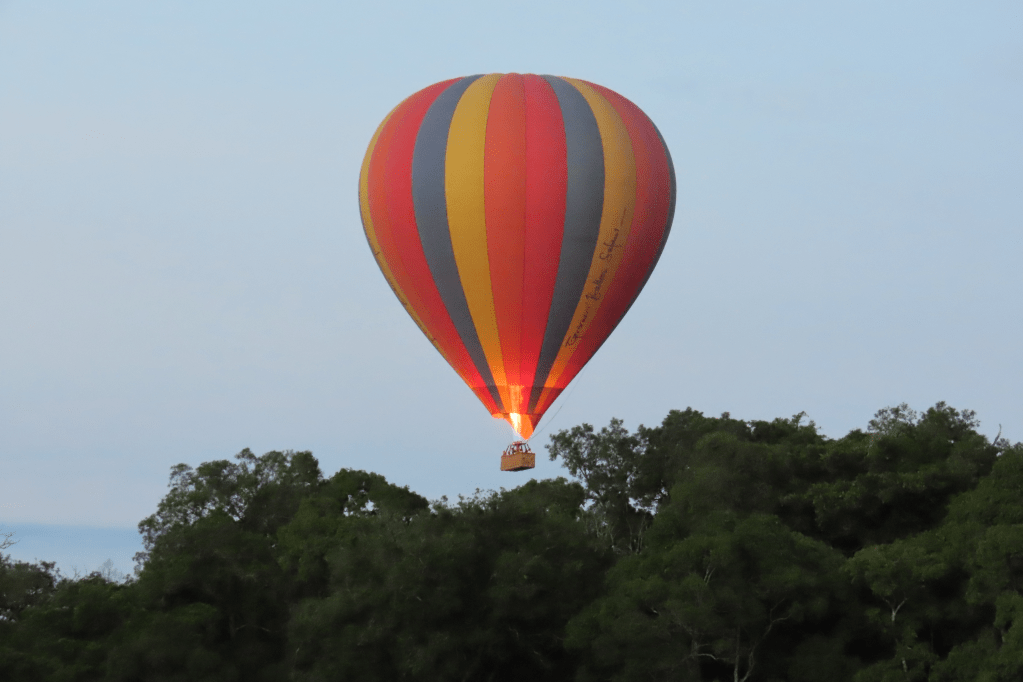
We turned down the opportunity to have the airborne experience, preferring to have Simon’s company the whole time. From what we gathered, the balloon baskets can take up to 16 people, which potentially makes it very cosy.
The meals we had out on the drives were up to the same standard, with lots of choice for all tastes. Simon had to double up as a waiter, which he did without seemingly any effort. And again, the time eating was also time to look at animals and birds (I know – birds are animals too but you know what I mean!).
Getting up before 6am every day was a bit of an effort, I must admit, but we knew it would be worth it and every morning we weren’t disappointed. And the superb breakfasts overlooking the river to the edge off any hardship.
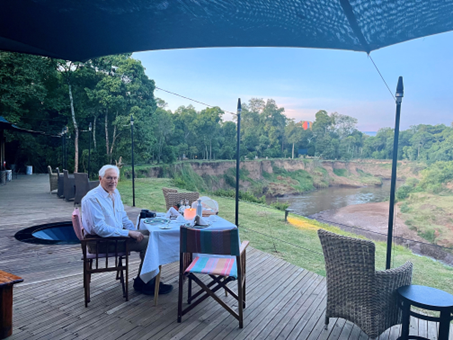
But a favourite part of the day, of course, was about 5pm when it was Sun-downer time. We’d stop at one of Simon’s favourite spots, overlooking the river or a couple of ponds with plenty of wildlife and, as the photo of him shows, Simon would turn into a cocktail waiter for us (to enjoy our favourite tipple – mine was always Amarula (hard to believe but apparently I got through the whole bottle), while Sabine was more a G&T girl).

And then there was a drink waiting for us in our tent when we got back before dinner, all part of the all-inclusive tariff!
The next two stories, you’ll be pleased to know, will be about the animals and the birds. I will also send a link to the OneDrive folder that has the photos. There are well over a thousand, including duplications between Simon/Sabina and me, so I have a lot of sorting out.
 Pete's Perusings