10th and 11th August 2023
I had been reflecting on the things that had not worked out as planned on our holiday. I couldn’t blame the French for the storm that meant Condor had to cancel the ferry to St Malo on the 2nd August and bring our sailing forward a day to my birthday, nor for the sunroof not wanting to close as we waited to board. And some other things could have happened no matter where you were.
But …. there was a village outside Saumur that seemed to go out of its way to make our lives as difficult as possible. We’d seen an advertisement for weathervanes in the Saumur visitors’ guide when we first arrived at our chambre d’hôtes. We were intrigued and just wanted to see what the blacksmith had.
On Google Maps, the workshop was fairly close to Chateau Brézé that we wanted to visit the next morning. It looked easy to get there, an unusual tourist place to visit and possibly relevant for the house in Scotland, and we liked the idea of supporting a local artisan, even if we only turn up, show an interest but don’t buy anything. Mmmm.
It would be a mistake to think that two dates above, 10th and 11th August, were required because we had visited a retail establishment one day, made a purchase that needed some finishing touches and had returned the next day to collect our purchase. That would completely miss the point that we were in France in August.
While on the subject of difficulties, I need to get this out of the way early on and I won’t mention it again. The word “weathervane” is not that easy to say if you happen to be German. It has two parts, the first starting with a “w” and the second with a “v”. In English the letters have different sounds but the word is fairly simple to say. However, in German the two letters have the same sound (“v”) as there is no “w” sound. And then the “th” in the middle of the first part can be awkward too as it sounds like a “t” in German but can come out as “zz”.
So when you’re with a German who is fluent in English and who therefore understands to the need to not sound like a German when articulating the first part but in mid-word change to sounding like a German for the second part, you can get a variety of words articulated, sometimes in quick succession if the first attempt(s) didn’t quite get it right. Usually followed by a laugh.
For any reader who is sufficiently interested in other people’s languages, the French for weathervane is “la girouette” and in German it’s an almost direct correlation – “die Wetterfahne”, pronounced Vetterfarne. Neither word is important to this story.
There might be something else that needs explaining. I use the term “blacksmith” when possibly the correct term is “metal worker”, especially as no horses needing shoeing were in evidence. However, it seems such a boring term for a skilled craftsman, an artisan, someone with so much creative flair, that I have reverted to using the old term to make it sound a little more inspiring. I hope you don’t mind. And, No, I’m not going to give you the translation for those words in French and German as well.
I can thoroughly recommend Chateau Brézé, an extraordinary mix of above and below ground construction dating back at least 1000 years. Troglodyte stuff. I still can’t understand why the lords needed 4,000 doves and pigeons – think of the mess, never mind the fact that they ate most of the corn in the fields planted by the peasants. Vive La Révolution.
Our first mistake was not to have lunch there – in our defence, it wasn’t much of a café, more geared to wine tasting which we did do, and the village where we were headed to visit the blacksmith looked like it would provide us with some culinary relief. Even we realised that going to the blacksmith over lunchtime was a no-hoper, but Google Maps showed there was a bar and a shop in the village of Le Coudray-Macouard where the blacksmith was located, so lunch was sorted. Or so we thought.
We arrived in the village at about 1.30 pm, a little late for lunch perhaps but still within the traditional 12 to 2pm window. We parked the car in a little car park under a tree to get a little shade. A family were sitting on a wall by their car having un petit picnic and in hindsight, that should have been a warning. We wandered up the narrow main street that ran through the village looking for the bar. As per usual, no-one was around, but they’d all be in the bar, having lunch, wouldn’t they?
We found the bar fairly quickly. There was a folding sign on the side of the road advertising its presence opposite to traffic in both directions but the locals certainly weren’t having lunch there. The main problem with the bar was that it was closed. Not just closed, but closed and for sale with the blinds down and looking very unloved.
Never mind, I said. There’s a shop a little further up the road that will open again at 2pm. We walked further up the street to the shop which also had a sign outside on the pavement advertising sandwiches and drinks, with an ice-cream parlour attached at the side, all closed of course because it wasn’t yet 2pm. Except that the sign on the door told us that the shop didn’t open till 3.30pm. They took a three hour lunch.
Nothing else for it – we’d have to do without lunch in the village, see the blacksmith and get something later on the way back to Saumur, or wait and eat in the town itself. Not a problem. We’d had a good breakfast, we told ourselves. But was there a maxim of never buy a weathervane on an empty stomach? We carried on walking and quickly found the little side road that the blacksmith was on.
But right on the corner was a tearoom. Hallelujah. I must have missed it on Google Maps. It was called Rosamée and looked absolutely charming, with a garden with a pergola and paths under and on which little tables and chairs were placed. It looked like we had the place to ourselves, though, which was strange given the time of day and the fact that the bar wasn’t open. Until we read the sign saying Open Friday, Saturday and Sunday 11.00 to 19.00. Today was Thursday. Merdre.
So three out of the four businesses in the village we’d wanted to patronise were closed. It was now after 2pm so we headed down the short sideroad to the blacksmith. We could see the gate to his place and some large sheds – looked quite an operation. The gate was positioned across the entrance in a blocking unwelcoming sort of way and when we got to it there were no cars in the forecourt beyond.
By then, we knew to look out for a sign and there it was – opening hours 08.00 to 13.30 Monday to Friday. Double merdre. We’d missed them by about 30 minutes. But then, we thought: What – they only work five and a half hours a day? Even in France. No, that can’t be right. They must be about to re-open, say at 2.30 or 3pm. But re-reading the sign twice and looking helplessly over the gate at the empty facility didn’t change anything. It was well and truly fermé. It gave out that desolate feeling that told you it would stay like that for almost another 18 hours. Four out of four. 100%.
And you feel so stupid, standing there in the heat of the day, mouth opening and closing but no sound coming out that could possibly express your frustration, looking at the buildings and forecourt devoid of life, the closed gate saying to you that its sole purpose in life is to stop you from doing something you shouldn’t, like walking into an area that is closed until 8am the next morning.
We walked back to the car with our tail between our legs. The side trip to look at the church didn’t help much, especially as it was up a steep road and we were tired and hot. We were also expecting that it too would be closed, five out of five, but Him Up There understood our plight – the church was open, cool and tranquil, but it wasn’t enough to make us feel uplifted.
Our initial reaction to this experience is unprintable. Our incredulity at a business that advertises in a significant local tourist publication but omits a really important piece of information (come early to avoid disappointment), a bar where the owners couldn’t be bothered to take the sign off the road before closing the establishment for good, a shop advertising sandwiches that’s closed for 3 hours at lunchtime, and a tearoom only open 3 days a week in the middle of the summer.
And we’d checked their very good website and I didn’t remember seeing those limited hours. I checked it again when I started writing this article and sure enough the hours are what you’d expect, open in the morning, an hour or so for lunch and open in the afternoon. I must have stopped looking when I saw that. But only if you scroll down, out of sight of the normal hours, do you see they tell you that “exceptionellement”, it was only open those more limited hours that particular week – and closed completely for the two weeks after. In retrospect, how lucky were we to catch them on their last day!
We saw the exceptionally word a lot on this holiday to preface the announcement of something bad, usually something closed that coincided with not only our visit, but peak summertime. A perfect example of this was the Saumur Theatre which had notices and leaflets all over the town advertising its exhibition of tapestries from Aubusson, famous for tapestries since the 16th century. When we went to see the exhibition, we couldn’t find a main door of the Theatre building that was open, and eventually came to one that told us that “exceptionellement” the Theatre would be closed 7th to 11th August, the week we were there.
Back to the blacksmith’s closed workshop. How disconsolate were we? A lot was the answer and some ripe language was heard on the way back to Saumur. But not disconsolate enough, obviously, because we did decide to go back the next day. Our interest in weathervanes had been sufficiently piqued to return the next morning, Friday, when perhaps, without pushing our luck too much, both the blacksmith and the tearoom might welcome us.
And we were right on one count, the blacksmith. He was open – hooray! We parked in the carpark off the street outside and walked across the road, through the forecourt and into a large shed that was connected to another one behind. Off the forecourt there were other large sheds that was occupied by at least one other business that also managed to work an onerous 5 hours a day. Metal worked shapes of various dimensions greeted us – round window frames that would sit out on the sloping roof of old buildings, the large pointed pinnacle of an old tower, huge decorative fleurs des Lis. Clearly, if you had a run-down chateau and plenty of money, this was the place to come to get help with the restoration.
In the centre of the forecourt was a metal pole with lots of metal arms and on the arms were a variety of weathervanes. And the variety was enormous. We stopped to admire them and think through the huge number of options. First, did we want one to mount on the chimney or a post in the garden? Then, which of the themes would we be interested in – animals, water, scenes of life, nature, occupations, one for mechanics (with cars), or fantasy? Did we want to design one ourselves and let them make it (obviously a non-starter for us)? How did you want the points of the compass below the image to be displayed? Mon Dieu.
And the choice within both the themes and the compass points was huge, even with the ready-made weathervanes on display. I suppose the first question really was did we want one at all? Of course we did. We’d have been kidding ourselves if we’d gone this far and not bought one. And for Rhu, it would be perfect fixed to the top of a fence post in sight of the kitchen doors.
The blacksmith was in his workshop and asked in French if he could help us. Sabine to the rescue. Yes, it was fine if we wanted to just look around. In the end the choice was easy. We settled on the Gallic Rooster that we had taken a shine to right at the start, with a star, the moon and the sun and just one compass point (S), with all the figurines made in copper. It came in two pieces, the rooster and arrow fitting over the pole that the compass points were attached to with the secret ingredient being a small marble-like ball that sat on top of the pole to allow the rooster to turn in the wind. Ingenious.
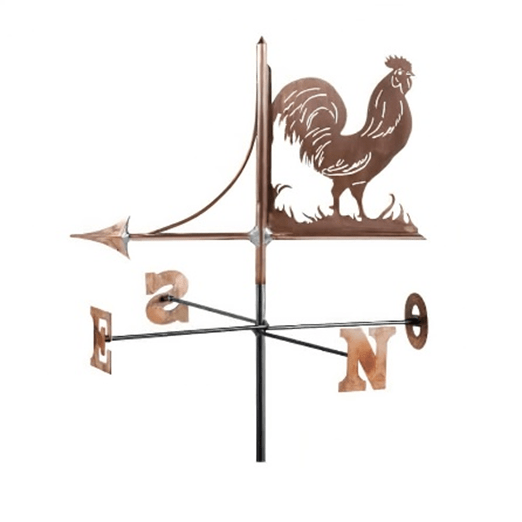
All this was explained in French by the blacksmith, the Atelier de la Girouetterie as the business was called (https://www.girouette.com/). Thank you, my lovely German girlfriend, for being able to handle that side of things. The atelier called his young assistant, possibly his daughter, who had been working in the rear shed, to come and deal with the finance side of things. He set about wrapping the two parts, an awkward job given the spikey components that mercifully appeared he’d done before. It was now about 12.50pm.
The cost was a not inconsiderable €490, a lot more than I’d thought it would be (if I’d thought about it much at all) but heigh-ho, it was a piece of true craftsmanship, came with our story in getting it, we really loved it and we’d already erected it in our minds in the garden in Rhu. I produced my Lloyds euro account debit card and we thought we were back in Austria – je suis desolé, pas de cartes. Only cheques or cash. Quoi? You’ve got to be joking!
I knew we had less than €150 in cash between us. Once they had determined that payment by cheque was not going to happen, the assistant told us there was un bankomat at the Carrefour in Distré, four kilometres away back towards Saumur, where we could get cash out. I remembered seeing the sign for Distré when we had left empty-handed the day before and had driven back to Saumur that way. Great. Stressful? You bet!
Thank heavens for Google Maps which located the supermarket and guided us there. At least it was off the main road and not in the middle of the town. It involved going to the second roundabout, coming back in the direction we’d come, and immediately taking a slip road into the shopping mall carpark. You didn’t want to miss that slip road because it was off a dual carriageway and we’d have to drive back to the end of it, turn around at the first roundabout and come all the way back.
So far so good. But where to park, where was the cash machine? By that time, we’d agreed that if they wanted the sale, they’d stay around if this took us longer than 30 minutes. But that attitude didn’t help an awful lot. We still felt very stressed. I left Sabine in the car and ran to the shopping mall main entrance.
I found the cash machine easily enough, correctly reckoning that it would be just inside the main entrance which was also the entrance to the Carrefour. Phew. I chose €400 and the machine refused the transaction. I was sure I had enough cash in the account. I tried €300 and it worked. Phew. Out came 30 €10 notes. I wasn’t going to count them and we were still about €50 short. I put the card in again, this time opting for the lowest amount on the list, an interestingly high €120. Out came 12 €10 notes. Phew.
I couldn’t stuff them all in my wallet. I felt like someone who’d won the jackpot in Vegas on a slot machine with a ton of quarters to have to scoop up. So I went back to the car trying not to look like someone with 42 €10 notes in my pockets. I gave them to Sabine along with my other cash and she counted out the required amount, including the €50 note that she’d had trouble using the day before.
We still had time. We could feel the stress completely dissipating as we drove back. The blacksmith and his assistant welcomed us with open arms and the exchange took place. Smiles all round. They waved us goodbye – as we now know, they were about to start their two week holiday, so no wonder they were happy, especially with an extra and unexpected nearly €500 in cash in their pockets.
Time for lunch. 1.30pm again like the day before, but the tearoom was open all afternoon. We put the weathervane in the car and walked up the sideroad to the corner where the entrance to the tearoom was. It meant we walked past the garden area and could see a lot of people having lunch, but there were still a couple of empty tables. All good. And all that stress had made us quite hungry. We were looking forward to a lovely lunch in their lovely garden. Sabine said she might even have some wine.
What happened next is still a bit of a blur. That’s because it shouldn’t have happened at all and in trying to make sense of it, it just becomes even more opaque. I remember we approached an empty table, and were about to sit down when Sabine quite properly said we should wait for the woman serving another table not far away and ask if we could sit there. Which we did and which Sabine did in French.
This woman looked like she’d been struck by lightning. She just stood there, stared at us blankly and shook her head in an uncomprehending manner and asked Sabine to repeat the question. Which Sabine did, still the same reaction. The French couple sitting at the nearest table couldn’t help but overhear, understood Sabine perfectly well and relayed our request to the woman in their French. At this point she came to life, and looked around her at each table in the garden, appearing to count the number of people waiting for their lunch. At which point she turned on her heel and walked away from us saying something like “I need to ask” but in a very dismissive way. And didn’t come back.
Once again in this small village, we had our mouths open. Her rudeness was breathtaking. We weren’t in any hurry, lunch was being served and the place was open till 7pm, for heaven’s sake. All she had to do was say it might take a while, or even tell us we could only eat cake as one her fellow countrywomen is quoted as saying, but “Bienvenue” nevertheless. But No, quite the opposite.
We stood there for a couple of minutes feeling like we were sticking out like a sore thumb and then a wave of anger got the better of us both. We slowly walked back up the path and left. No-one called to us to come back. On our way to the car, we saw that the woman had reappeared and was serving one of the tables, not looking for us or beckoning to us. Had she simply waited for us to leave before resuming her table service?
This establishment gets an astonishing 4.9* rating on Google Maps. That’s before Sabine has given them our experience. And I’d put one of those €10 notes on getting a gallic shrug in response. France can still be France pour les anglais.
 Pete's Perusings